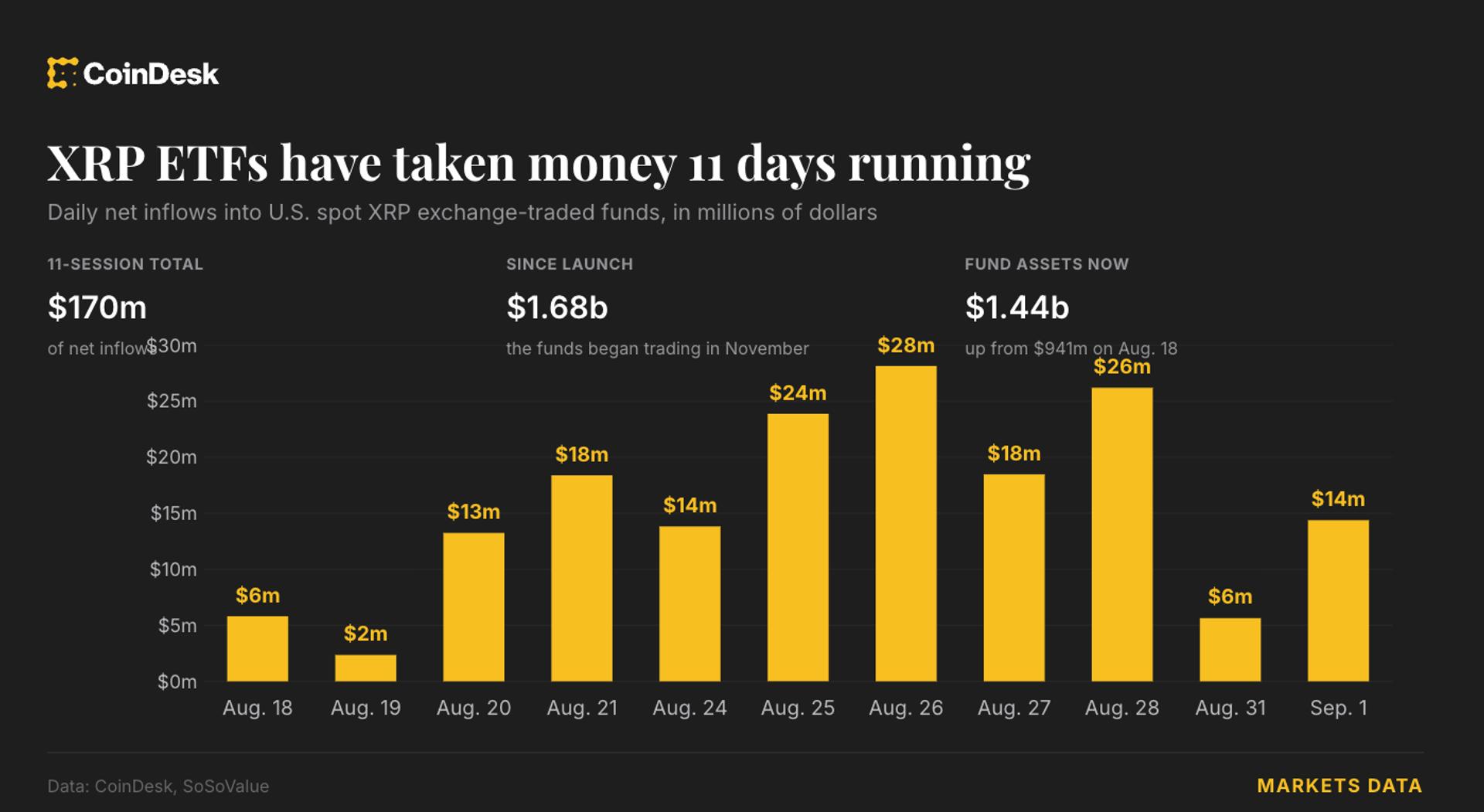
XRP ETFs Attract $170 Million: A Watershed Moment for Institutional Adoption
The cryptocurrency market is witnessing a significant evolution, with institutional players increasingly integrating digital assets into their portfolios. A compelling recent development underscoring this trend is the remarkable performance of spot XRP Exchange-Traded Funds (ETFs), which have collectively pulled in an impressive $170 million over the past eleven days. This inflow is not merely a fleeting blip; it represents a sustained interest, marked by nine consecutive sessions of positive inflows, and more importantly, the emergence of Wall Street titans like Goldman Sachs, Jane Street, and Millennium as prominent institutional holders. As a Senior Crypto Analyst, I believe these developments signal a pivotal shift in how traditional finance views and engages with XRP, positioning it for potentially transformative growth and wider acceptance.
The Inflow Phenomenon: Sustained Interest and Market Confidence
The $170 million figure is robust, especially for an altcoin-specific ETF product that is relatively new to the institutional investment landscape. The consistency of these inflows—nine straight sessions—is perhaps even more telling than the sheer volume. It indicates a deliberate, sustained accumulation strategy by professional investors, rather than speculative, short-term plays. This steady accumulation suggests a growing conviction in XRP's long-term value proposition and increasing comfort with the underlying asset’s regulatory landscape following key developments in the Ripple-SEC legal battle.
Unlike the initial frenzy often seen with major asset launches, the measured yet continuous flow into XRP ETFs implies that institutions are conducting thorough due diligence and are strategically allocating capital. This type of organic, sustained growth is far more indicative of fundamental strength and investor confidence, laying a healthier foundation for future price stability and liquidity.
Goldman Sachs at the Helm: A Powerful Endorsement
The revelation that Goldman Sachs tops the list of institutional holders, alongside other financial powerhouses like Jane Street and Millennium, is arguably the most significant aspect of this news. Goldman Sachs is one of the oldest and most respected investment banks globally, and its substantial investment in XRP ETFs sends an unequivocal message to the broader financial world. It signifies that XRP, wrapped in an ETF structure, meets the stringent investment criteria and risk assessments of a tier-one financial institution.
Jane Street, a leading quantitative trading firm and market maker, and Millennium, a multi-strategy hedge fund, further bolster this narrative. Their involvement speaks to the increasing liquidity, accessibility, and perceived legitimacy of XRP as an investable asset class. These firms don't just invest; they often create and define market trends, providing critical liquidity and price discovery mechanisms. Their presence indicates a deepening market infrastructure around XRP, making it easier and safer for even more institutions to participate.
Why XRP? Unpacking the Institutional Investment Thesis
For institutional investors, the appeal of XRP likely extends beyond mere price speculation. Its core utility as a bridge currency for cross-border payments, facilitating rapid and low-cost international transfers via Ripple’s On-Demand Liquidity (ODL) network, presents a compelling value proposition. As global commerce becomes increasingly interconnected, the demand for efficient, real-time payment solutions is immense, and XRP is uniquely positioned to address this.
Crucially, the partial resolution of the SEC lawsuit against Ripple, which clarified that XRP is not a security when sold on exchanges, has been a game-changer. This legal clarity significantly de-risked XRP for institutional investors who operate under strict regulatory compliance frameworks. The ETF structure further enhances this by providing a regulated, accessible wrapper that simplifies custody and compliance, effectively bridging the gap between traditional finance and the crypto ecosystem.
Furthermore, institutions may be looking at XRP's potential for future integration into central bank digital currency (CBDC) initiatives or other forms of tokenized assets, leveraging its speed and efficiency. The ongoing development of the XRP Ledger and its ecosystem also adds to its long-term potential.
Market Implications and Future Outlook
The continuous institutional inflows into XRP ETFs are likely to have several profound implications. Firstly, increased institutional participation tends to bring greater market stability and depth. Large-scale buying by sophisticated entities can absorb volatility, leading to a more mature price discovery mechanism. Secondly, it validates the broader altcoin ETF market. If XRP ETFs prove successful, it could pave the way for similar products for other established cryptocurrencies, further expanding the institutional reach into the digital asset space.
From a price perspective, sustained institutional demand can create significant upward pressure on XRP's value over the long term, assuming supply remains relatively constant or adoption accelerates. However, it’s vital to temper expectations with realism; market dynamics are complex, and regulatory uncertainties, while mitigated for XRP, still exist for the broader crypto market. Nonetheless, the trend is clear: institutions are not just dabbling; they are making strategic, long-term plays in digital assets that offer clear utility and regulatory clarity.
Conclusion: XRP's Maturation as an Institutional Asset
The $170 million in inflows over eleven days, topped by Goldman Sachs's prominent involvement in XRP ETFs, is a resounding affirmation of XRP's growing legitimacy and appeal within traditional finance. It marks a significant step in the maturation of digital assets, moving them from niche speculative instruments to bona fide institutional investment vehicles. For XRP, this indicates a strong vote of confidence in its underlying technology, its utility, and its evolving regulatory standing. As institutional capital continues to flow into this space, XRP is increasingly positioned as a key player in the ongoing convergence of traditional finance and the decentralized economy, hinting at a future where digital assets are an indispensable component of global financial architecture.