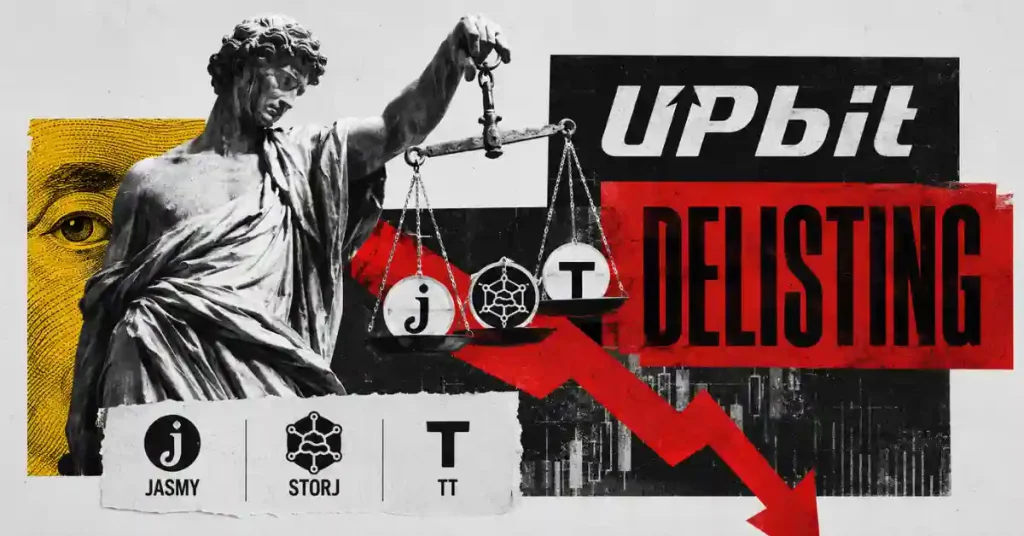
Upbit Delisting Notification: A Warning Shot Heard Across the Altcoin Market
The cryptocurrency market, ever-sensitive to regulatory and exchange actions, recently received a significant tremor from South Korea's major exchange, Upbit. In a move that sends a clear message to projects across the ecosystem, Upbit has announced its decision to delist three altcoins: Storage (STORJ), ThunderCore (TT), and Jasmy Coin (JASMY). While the final trading support is scheduled to cease on September 14, 2026 – a remarkably distant two years from now – the implications of this announcement are immediate and profound, casting a long shadow over the future viability and market perception of these projects.
This isn't an overnight decision. Upbit had previously placed STORJ under a 'trading caution' on July 28, an indicator that the exchange was actively monitoring the asset for potential issues. While the source context doesn't specify similar warnings for TT and JASMY, it's highly probable that they too have been under scrutiny, or are being grouped due to shared underlying concerns that triggered Upbit's evaluation process. Such warnings typically precede delisting decisions, giving projects a chance to rectify identified issues, though it appears that, in this instance, those efforts either failed or were deemed insufficient by the exchange.
The Significance of a Two-Year Delisting Window
The extended delisting timeline, stretching until September 2026, is a critical element of this announcement. Unlike abrupt delistings that often trigger immediate price crashes and panic selling, this protracted period acts as a prolonged warning. For current holders, it provides an ample window to consider their positions, liquidate assets, or migrate to other platforms if these tokens remain listed elsewhere. For the projects themselves – STORJ, TT, and JASMY – it's a double-edged sword: a grace period to address the fundamental issues leading to the delisting, but also a two-year period under a cloud of uncertainty, making it incredibly challenging to attract new investors or forge significant partnerships.
During this extended timeframe, investor confidence will likely be severely eroded. The delisting announcement signals a fundamental lack of trust or a failure to meet Upbit's stringent listing criteria. This can deter institutional investment, stifle community growth, and create a prolonged downward pressure on price and trading volume, ironically exacerbating some of the very issues that might have led to the delisting in the first place.
Analyzing the Potential Reasons for Delisting
While Upbit has not publicly detailed the specific reasons for each delisting, common factors that lead exchanges to remove assets include:
- **Low Trading Volume and Liquidity:** Projects that fail to maintain consistent trading volume can become illiquid, making it difficult for users to buy or sell without significant price impact. Exchanges incur costs for listing and maintaining trading pairs, and low-volume assets offer poor return on investment.
- **Lack of Project Development or Ecosystem Growth:** Projects that fail to deliver on their roadmap, show stagnating development activity, or struggle to foster a vibrant ecosystem often lose relevance and utility.
- **Regulatory Concerns and Compliance Issues:** Given South Korea's strict regulatory environment, compliance is paramount. Tokens that face legal ambiguities, operate in grey areas, or fail to adhere to evolving crypto regulations are prime candidates for delisting.
- **Technical Issues or Security Vulnerabilities:** Persistent network issues, smart contract bugs, or security breaches can lead to a loss of user trust and put exchange users at risk.
- **Lack of Transparency or Community Engagement:** Projects that are opaque about their operations, fail to communicate effectively with their community, or show signs of manipulative trading can also be flagged.
Impact on STORJ, TT, and JASMY
Let's consider each project in light of these potential reasons:
- **Storage (STORJ):** As a decentralized cloud storage network, STORJ has been around for some time, making it a relatively established project. Its delisting suggests that perhaps its growth in adoption, trading volume on Upbit, or its ability to meet specific regulatory classifications in South Korea might be the underlying concern. Despite its utility, competitive pressures in the data storage sector are immense, and perhaps STORJ has not maintained the momentum Upbit expects.
- **ThunderCore (TT):** ThunderCore is an EVM-compatible blockchain platform focused on scalability for dApps and gaming. The Layer-1 space is incredibly competitive, and many such chains struggle to gain significant developer and user traction. Low network activity, insufficient dApp ecosystem growth, or failure to stand out in a crowded market could be contributing factors to its delisting.
- **Jasmy Coin (JASMY):** Often branded as 'Japan's Bitcoin' for its focus on IoT data, JASMY has garnered significant retail interest but has also faced scrutiny regarding its utility, tokenomics, and actual adoption. Projects with high token supply, unclear value proposition beyond hype, or a perceived lack of tangible progress on their core mission often become targets for exchanges seeking to prune less viable assets. Regulatory bodies, especially in conservative markets like South Korea, might also be wary of projects that attract speculative trading without robust underlying fundamentals.
Broader Market Implications and Investor Prudence
This Upbit delisting serves as a potent reminder for the broader altcoin market and individual investors alike. It underscores the increasing scrutiny exchanges are placing on listed assets, moving beyond initial listing enthusiasm to demand sustained performance, utility, and compliance. As regulatory frameworks tighten globally, exchanges are likely to continue cleaning up their rosters, prioritizing high-quality, compliant projects over those with flagging fundamentals or regulatory ambiguity.
For investors holding STORJ, TT, or JASMY, the next two years represent a critical period. It is imperative to conduct thorough due diligence, monitor project developments closely, and evaluate exit strategies. The projects themselves face an arduous battle to regain trust and demonstrate a compelling reason for continued existence and trading on other platforms. This delisting, while delayed, is a significant blow to their market credibility and will undoubtedly impact their liquidity and investor appeal going forward.
In conclusion, Upbit's decision is more than just an exchange listing update; it's a strategic move reflecting evolving market standards and regulatory pressures. It reinforces the notion that even established altcoins are not immune to delisting if they fail to meet the increasingly rigorous demands of major trading platforms. Investors and project teams alike should heed this warning as a signal for a more mature, and perhaps more selective, crypto market ahead.
Featured News Partner: Coinpedia News