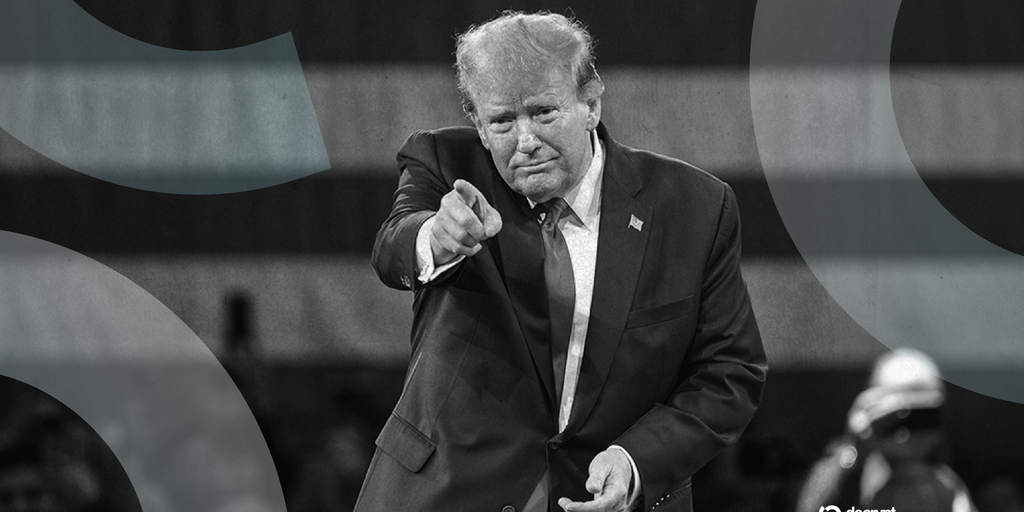
Trump Calls for Crypto Clarity Amidst Election Season
In a significant move that underscores the growing political weight of the cryptocurrency industry, former President Donald Trump recently called on Congress to pass a 'fair version' of the Clarity Act during a White House crypto meeting. This declaration, coupled with an explicit mention of efforts to bring the high-performance decentralized exchange (DEX) Hyperliquid into the U.S. under a compliant framework, signals a potentially transformative shift in the nation's approach to digital asset regulation. As a senior crypto analyst, I view this as a pivotal moment that could redefine the regulatory trajectory for blockchain innovation and market participation in the United States.
The 'Clarity Act': A Beacon for Regulatory Certainty?
The concept of a 'Clarity Act' has long been a rallying cry for the crypto industry, which has struggled under a patchwork of ambiguous regulations and an enforcement-led approach from various agencies. While no formal bill currently bears this exact name, the sentiment refers to the urgent need for comprehensive legislative frameworks that provide clear definitions for digital assets, delineate jurisdictional boundaries among regulators (e.g., SEC vs. CFTC), and establish a predictable operating environment for businesses.
Trump's emphasis on a 'fair version' is particularly noteworthy. It suggests an intent to balance robust consumer protection and market integrity with fostering innovation and economic growth. A 'fair' framework would likely avoid overly burdensome regulations that stifle technological advancement or push talent overseas, while still safeguarding investors from fraud and market manipulation. Such legislation could classify digital assets definitively as securities, commodities, or a new asset class, thereby providing a much-needed roadmap for issuers, exchanges, and investors.
Hyperliquid's Inclusion: A Decentralized Game-Changer?
Perhaps the most intriguing detail from the meeting was the explicit mention of bringing Hyperliquid into the U.S. under a compliant framework. Hyperliquid is a prominent perpetuals DEX known for its high-throughput and capital efficiency. Its inclusion is significant for several reasons:
- DeFi Recognition: It signifies a potential acknowledgment by policymakers of the importance and innovation within the decentralized finance (DeFi) sector. Historically, regulators have struggled with how to oversee truly decentralized protocols, often resorting to targeting centralized interfaces or developers.
- Compliance for Decentralization: The challenge of bringing a DEX like Hyperliquid into a 'compliant framework' is immense. Decentralized protocols often lack a central entity responsible for KYC/AML (Know Your Customer/Anti-Money Laundering) or traditional corporate structures. This suggests an exploration of novel compliance models that could accommodate the unique architecture of DeFi, perhaps through smart contract audits, front-end regulatory compliance, or even decentralized autonomous organization (DAO) liability frameworks.
- Derivatives Market Implications: Hyperliquid specializes in perpetual futures, a highly sought-after but tightly regulated segment of the financial market. Creating a compliant pathway for such a platform could unlock significant innovation and liquidity in regulated crypto derivatives within the U.S., potentially competing with offshore venues.
The fact that Trump's administration is reportedly working on this suggests a willingness to tackle the complexities of integrating decentralized protocols into the existing regulatory apparatus, rather than simply dismissing them as non-compliant.
Broader Implications for the Crypto Ecosystem
Trump's renewed embrace of crypto carries substantial weight, especially in an election year. His administration's stated intent to foster a crypto-friendly environment could yield several critical outcomes:
- Political Leverage: It positions him as a champion for the rapidly growing crypto voter bloc, contrasting with what some perceive as a more hostile stance from the current administration, characterized by enforcement actions and a lack of legislative progress.
- Investor Confidence: Clear regulatory frameworks can significantly boost institutional and retail investor confidence, potentially attracting more capital into the U.S. crypto market.
- Innovation Retention: By providing a clearer path, the U.S. could stem the 'brain drain' of crypto innovation to more permissive jurisdictions, ensuring that American companies remain at the forefront of blockchain development.
- Global Competitiveness: A well-defined regulatory stance could enhance the U.S.'s position as a global leader in financial technology, rather than lagging behind countries that have already adopted comprehensive crypto laws.
However, the path forward is fraught with challenges. Legislative action is notoriously slow and requires bipartisan consensus, which is often elusive. Defining 'fair' will involve intense debate among industry participants, consumer advocates, and government agencies. Furthermore, the technical and legal complexities of regulating decentralized protocols like Hyperliquid without compromising their core principles of decentralization will require innovative thinking from all stakeholders.
The Road Ahead: A Moment of Opportunity and Scrutiny
Trump's call for a 'fair version' of the Clarity Act and the specific mention of Hyperliquid represent more than just campaign rhetoric; they signal a potential pivot towards a more proactive and accommodating regulatory approach to crypto in the U.S. While the details of such legislation remain to be seen, the intent to provide clarity and accommodate decentralized innovation is a significant development for the entire industry.
The coming months will be crucial. The crypto community must engage constructively with policymakers to ensure that any forthcoming legislation is truly fair, comprehensive, and forward-looking. The ambition to bring innovative platforms like Hyperliquid into a compliant framework could set a global precedent for how decentralized technologies are integrated into traditional financial systems, marking a new chapter for the digital asset landscape in America.