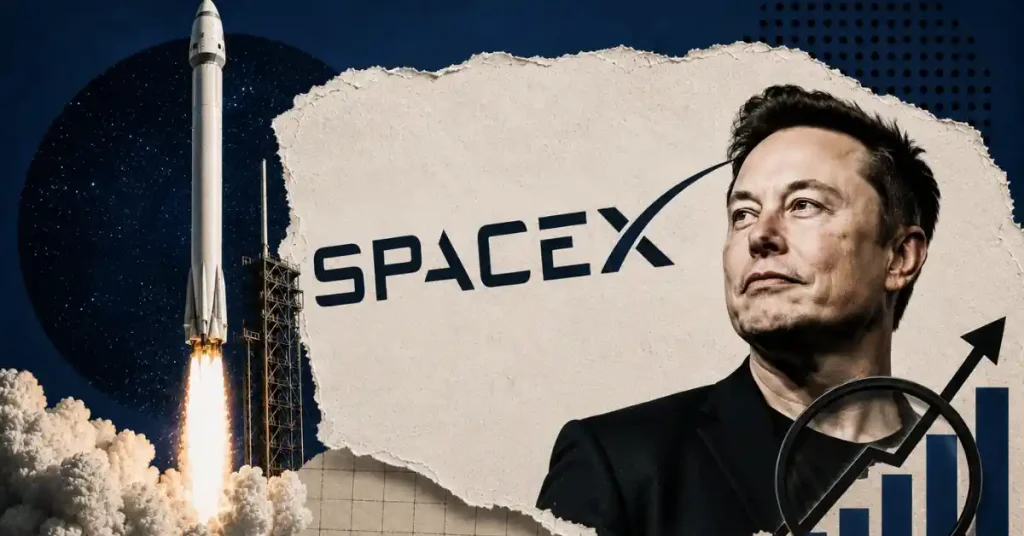
SpaceX's Post-IPO Debut: Stellar Growth, Strategic Losses, and the Long Game of Space Disruption
In a highly anticipated financial disclosure that sent ripples across global markets, Space Exploration Technologies Corp (NASDAQ: SPCX), more commonly known as SpaceX, has released its inaugural quarterly earnings report since its monumental initial public offering (IPO) just two months prior. The Q2 2026 report presents a fascinating dichotomy: a company that unequivocally beat major analyst estimates yet simultaneously reported a considerable loss, leading to an intriguing period of stock underperformance. As a senior crypto analyst, I view this not merely as a standard corporate earnings update, but as a critical barometer for the future of frontier technology, infrastructural innovation, and the long-term investment philosophy that often underpins groundbreaking ventures, mirroring the ethos often found within the blockchain and Web3 ecosystems.
Unpacking the Q2 2026 Numbers: A Paradox of Performance
The headline news — SpaceX beating major estimates — is a testament to its robust operational momentum and the insatiable demand for its services. While the specific figures are not detailed in the provided context, “beating estimates” for a company like SpaceX typically signifies stronger-than-expected revenue generation from its varied divisions. This likely includes surging subscription numbers for its Starlink satellite internet service, a growing cadence of lucrative launch contracts for both government and commercial clients, and potentially progress in its ancillary space-related ventures. Such performance underscores the company’s capacity to execute on its ambitious projects and capture market share in an increasingly competitive space economy.
However, the narrative takes a turn with the acknowledgment of a “considerable loss.” For many traditional investors fixated on quarterly profitability, this might raise a red flag. Yet, from a perspective accustomed to evaluating disruptive, high-growth tech companies — much like those pioneering Web3 infrastructure — a significant loss can be a strategic indicator. It suggests aggressive reinvestment into research and development (R&D) for projects like Starship, the next-generation fully reusable launch system, as well as continued expansion of the Starlink satellite constellation. Building foundational, global infrastructure — whether it’s a decentralized internet or a multi-planetary transport system — demands immense upfront capital and a long-term vision that often sacrifices immediate profits for future dominance and exponential growth.
The Market’s Reaction: Short-Term Jitters vs. Long-Term Vision
The reported “stock underperformance” following an earnings beat is perhaps the most intriguing aspect for market observers. This could be attributed to several factors. Firstly, the initial IPO valuation might have been exceedingly high, baking in significant future growth expectations. Secondly, broader market sentiment, perhaps leaning towards caution or a “flight to quality” amidst macro-economic uncertainties, might penalize companies that are not yet cash-flow positive. Thirdly, despite beating revenue estimates, the “considerable loss” likely spooked some investors who prioritize short-term profitability over long-term strategic investments. This dynamic highlights a perpetual tension in capital markets: the struggle between impatient short-term trading and the patient, visionary capital required to fund truly transformative technologies.
SpaceX: An Infrastructure Powerhouse with Web3 Parallels
From the vantage point of a crypto analyst, SpaceX embodies many principles that resonate deeply within the Web3 space. Starlink, for instance, is fundamentally building a global, distributed network infrastructure — a “decentralized internet” in terms of its physical architecture, providing resilient and low-latency connectivity to underserved regions worldwide. This echoes the ambition of blockchain projects aiming to create decentralized data storage, computing, or communication layers. The network effect of Starlink, as it scales, creates a powerful moat and an invaluable global data backbone, much like successful decentralized protocols aim to achieve.
Furthermore, SpaceX's relentless pursuit of Starship to make humanity multi-planetary is not just about rockets; it’s about fundamentally altering the economics of space access. By drastically reducing launch costs, SpaceX is effectively “permissioning” a new frontier for countless industries, researchers, and eventually, individuals. This mirrors the Web3 ideal of lowering barriers to entry, enabling new forms of value creation and participation in previously exclusive ecosystems. The potential for new space economies, facilitated by cheaper transport and ubiquitous connectivity, could foster an entirely new ecosystem of innovation, services, and even resource utilization — a concept not dissimilar to the expansion of digital economies through blockchain technology.
Challenges and the Road Ahead
Despite its visionary trajectory, SpaceX faces immense challenges. Regulatory hurdles are constant, competition in the space sector is intensifying, and the sheer capital expenditure required to bring Starship to full operational capacity and expand Starlink to global saturation is staggering. The path to sustained profitability, while secondary to growth for now, will eventually become paramount for long-term investor confidence.
For discerning investors and tech enthusiasts, subsequent earnings reports will be crucial. Key metrics to watch will include continued Starlink subscriber growth, Starship development milestones (especially successful orbital and full stack tests), progress on reducing launch costs, and any clearer indications of a pathway to positive cash flow. SpaceX’s journey is a high-stakes gamble on the future, but one that promises transformative returns if its ambitious vision can be fully realized.
Conclusion: A Visionary’s Volatility
SpaceX's first public earnings report for Q2 2026 offers a compelling snapshot of a company in hyper-growth mode. Beating estimates while reporting a loss is the hallmark of a disruptor prioritizing long-term market capture and foundational infrastructure build-out over immediate financial gratification. The initial stock underperformance serves as a reminder that the market often struggles to reconcile visionary ambitions with traditional quarterly metrics. However, for those who understand the profound impact of network effects, decentralized infrastructure, and the relentless pursuit of new frontiers — a perspective often cultivated in the crypto space — SpaceX remains one of the most exciting and pivotal companies to watch. Its journey will undoubtedly shape not just the future of space, but the very fabric of our interconnected world.
Featured News Partner: Coinpedia News