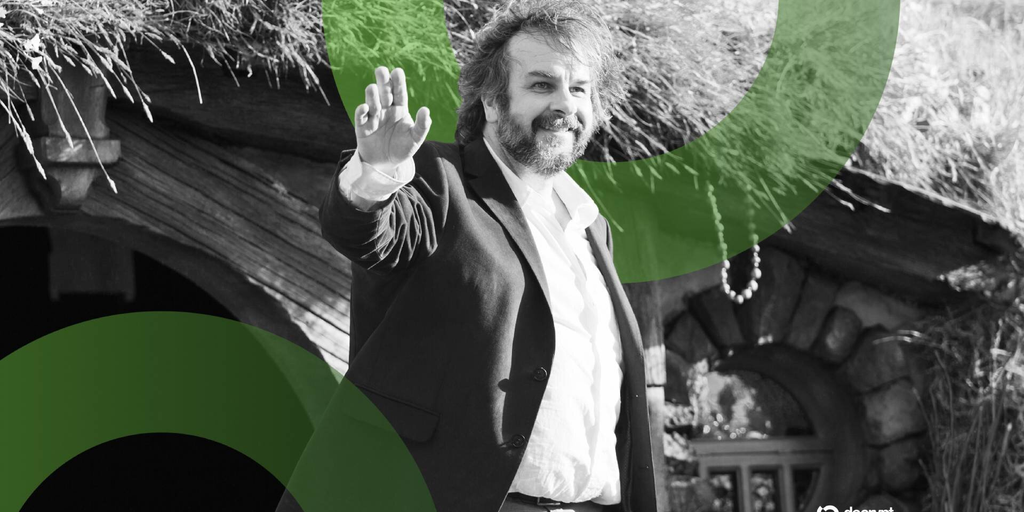
Peter Jackson's AI 'Special Effect' Remark: A Web3 Clarion Call for Hollywood's Creative Future
The venerable halls of Hollywood are currently gripped by a profound existential debate surrounding Artificial Intelligence. At its heart lies a tension between technological advancement and the preservation of human artistry and economic livelihoods. Famed 'Lord of the Rings' director Peter Jackson recently weighed in, famously dismissing AI as 'just a special effect' – a statement that, while perhaps intended to downplay the existential threat, inadvertently highlights a critical blind spot. From a crypto analyst's perspective, Jackson's comment, and the broader anxieties it represents, aren't just about special effects; they are a clarion call for the fundamental architectural shifts that Web3 technologies promise for the creative economy.
Jackson's concern that AI could 'hurt recognition for performance-capture acting' is particularly insightful. It speaks to the core problem of provenance, attribution, and value in an increasingly digitized and AI-augmented creative landscape. When AI can mimic voices, generate scripts, or even synthesize performances, how do we discern and compensate original human contribution? This is precisely where the decentralized, transparent, and immutable principles of blockchain technology and Web3 shine, offering robust solutions that go far beyond mere 'special effects'.
The Illusion of 'Just a Special Effect' vs. AI's Foundational Impact
To label AI merely a 'special effect' risks underestimating its transformative power. While AI certainly enhances visual effects, its true disruptive potential lies in its ability to automate, generate, and even autonomously create. This impacts not just the visual layer but the very genesis of creative works, from scriptwriting to character design, musical composition, and, crucially, performance. Hollywood's current strikes by writers and actors underscore a deep-seated fear: that AI will not just be a tool, but a competitor, eroding human jobs and intellectual property rights. This fear aligns perfectly with the crypto community's long-standing skepticism towards centralized power structures and data exploitation inherent in Web2 models.
The traditional entertainment industry, much like other Web2 giants, operates on a centralized model where studios and platforms hold significant control over intellectual property, distribution, and artist compensation. AI, in this context, can be seen as another powerful tool that further consolidates this control, potentially leading to a future where individual creators have even less leverage. Web3, conversely, advocates for decentralization, giving power back to the creators and users through concepts like digital ownership, verifiable scarcity, and direct compensation mechanisms.
NFTs: Verifying Human Performance in an AI World
Jackson's specific worry about performance-capture acting is a prime example of where Non-Fungible Tokens (NFTs) offer a compelling solution. Imagine an actor's unique performance data – their movements, expressions, and vocal nuances – being tokenized as an NFT. This NFT would serve as an immutable, verifiable certificate of authenticity and ownership for that specific performance. Even if AI then augments, alters, or incorporates elements of this performance into a larger digital production, the original human contribution, secured on a blockchain, remains undeniable.
This goes beyond simple credit; it enables new models for royalty distribution and perpetual compensation. Every time an AI-generated character utilizing an actor's tokenized performance is used, streamed, or licensed, smart contracts linked to the NFT could automatically distribute royalties to the original performer. This transforms intellectual property from a static, centrally managed asset into a dynamic, programmable one, ensuring ongoing recognition and financial benefit for the human artist, regardless of how AI iterates upon their work. It shifts the paradigm from studios owning everything to artists owning their unique digital fingerprints.
Web3 and the Future of the Creator Economy in Hollywood
The broader principles of Web3 – transparent ecosystems, decentralized autonomous organizations (DAOs), and direct peer-to-peer value transfer – provide a robust framework for Hollywood to navigate the AI revolution. DAOs, for instance, could enable groups of creators, technicians, and even fans to collectively own and govern production companies, IP, and distribution channels, democratizing decision-making and profit-sharing in ways that current studio models cannot.
Furthermore, Web3's focus on user-centric ownership extends to digital identity and reputation. Actors, writers, and artists could maintain sovereign control over their digital likenesses, creative portfolios, and professional track records, secured on a blockchain. This immutable digital identity would be critical in proving authorship and contribution in an AI-saturated environment, empowering individuals against algorithmic exploitation.
Beyond 'Special Effects': Building a Fairer Creative Infrastructure
Peter Jackson is right to identify the potential for AI to diminish human recognition. However, his framing of AI as 'just a special effect' risks oversimplifying the profound infrastructural challenge and opportunity it presents. The real conversation for Hollywood isn't just about managing a new visual tool; it's about fundamentally rethinking how creative works are created, owned, distributed, and compensated in the digital age. Web3 offers not just 'special effects' but fundamental architectural solutions – decentralized, transparent, and equitable – to ensure that human artistry not only survives but thrives amidst the AI revolution.
For Hollywood to truly embrace the future without sacrificing its soul, it must look beyond superficial enhancements and consider the foundational shifts that Web3 technologies can provide. By leveraging blockchain for provenance, NFTs for digital rights, and DAOs for decentralized governance, the industry can build a more resilient, equitable, and creator-centric ecosystem where AI serves human creativity, rather than superseding it. The show must go on, but it needs a new script – written in code.