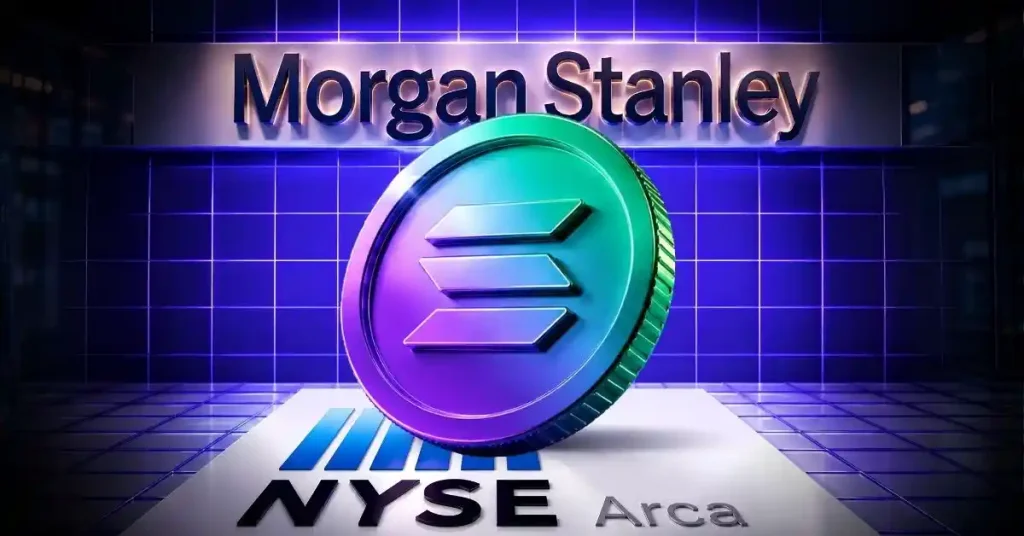
Morgan Stanley's Bold Entry Reshapes Crypto ETF Landscape
The institutional embrace of digital assets has reached a new crescendo with Morgan Stanley's decisive entry into the spot crypto ETF market. The financial behemoth, a long-standing titan in traditional finance, has officially launched the Morgan Stanley Ethereum Trust (MSSE) and the Morgan Stanley Solana Trust (MSOL) on NYSE Arca. This move is not merely an expansion of existing offerings; it represents a paradigm shift, setting new benchmarks for accessibility, cost-efficiency, and functionality within the burgeoning world of crypto investments. As a senior crypto analyst, I view this as a pivotal moment that will undoubtedly accelerate mainstream adoption and intensify competition, ultimately benefiting investors.
Unprecedented Value Proposition: Lowest Fees and Integrated Staking
What makes Morgan Stanley's new trusts particularly groundbreaking are their twin pillars of innovation: an industry-leading low expense ratio and the integration of staking rewards. At an annual expense ratio of just 0.14%, MSSE and MSOL immediately position themselves as the cheapest U.S. Ethereum and Solana ETFs available. This aggressive pricing strategy is a clear signal of Morgan Stanley's intent to capture significant market share and pressure competitors to follow suit. In a market where basis points can translate into millions over time, this low fee structure is a significant win for long-term investors seeking cost-effective exposure to these prominent altcoins.
However, the true game-changer lies in the inclusion of staking rewards. Both Ethereum (via Proof-of-Stake) and Solana leverage staking to secure their networks, a process that inherently generates yield for participants. By incorporating staking into their ETF structure, Morgan Stanley is offering investors a dual opportunity: potential capital appreciation from the underlying assets and a passive income stream from network participation. This hybrid model is a significant departure from traditional commodity-based ETFs, which typically only offer exposure to price movements. For institutional and retail investors alike, this means not only gaining exposure to the growth narratives of Ethereum and Solana but also earning additional returns, effectively enhancing the overall investment profile and potentially offsetting some of the holding costs. This feature significantly differentiates MSSE and MSOL from many existing or anticipated crypto ETPs, many of which are purely passive price trackers.
Institutional Validation and Market Ramifications
Morgan Stanley's foray with ETH and SOL ETFs on NYSE Arca sends an unequivocal message of institutional validation for these specific altcoins and the broader digital asset class. While Bitcoin ETFs marked a significant milestone, Morgan Stanley's decision to launch products for Ethereum, the backbone of decentralized finance and smart contracts, and Solana, a high-performance blockchain, underscores a growing recognition of their fundamental utility and long-term potential beyond just being speculative assets. This move by such a prominent financial institution lends immense credibility, potentially attracting a new wave of conservative institutional capital that has, until now, remained on the sidelines.
The impact on the competitive landscape cannot be overstated. We are likely to witness a fierce 'fee war' reminiscent of the early days of Bitcoin ETFs, where providers aggressively lowered costs to attract assets under management. This competition will inevitably benefit investors by driving down costs across the board. Furthermore, the availability of these highly liquid, regulated investment vehicles on a major exchange like NYSE Arca drastically lowers the barriers to entry for traditional investors. They no longer need to navigate the complexities of crypto wallets, exchanges, and self-custody to gain exposure to ETH and SOL, making these assets accessible within familiar investment frameworks.
Strategic Implications for Ethereum and Solana
From the perspective of the underlying assets, Morgan Stanley's new ETFs are a monumental tailwind. Increased institutional demand through these regulated products could lead to significant capital inflows into both Ethereum and Solana. For Ethereum, this further cements its position as a critical infrastructure layer for the next generation of the internet, attracting investment beyond its immediate utility as a gas token. For Solana, a relatively newer player in the smart contract platform space, this institutional backing is a powerful endorsement, potentially accelerating its adoption and developer growth. These ETFs provide a crucial on-ramp for vast pools of traditional capital that previously had limited avenues for direct exposure to these ecosystems.
Moreover, the integration of staking in the ETF structure has fascinating implications for the underlying networks' security and decentralization. By channeling capital into staking mechanisms, even indirectly, these ETFs contribute to the health and robustness of the Ethereum and Solana blockchains. It also introduces a layer of fundamental yield generation that can attract a different class of investor, one focused on cash flow in addition to capital appreciation, further diversifying the investor base for these assets.
The Dawn of a Multi-Asset Crypto ETF Era
Morgan Stanley's move signals the true beginning of a multi-asset crypto ETF era. While Bitcoin pioneered the space, the launch of ETH and SOL products by a major player like Morgan Stanley opens the floodgates for potential future altcoin ETFs. This diversification acknowledges that the crypto ecosystem is far more expansive than just Bitcoin, comprising a rich tapestry of technologies and use cases. As regulatory clarity improves and institutional comfort grows, we can anticipate a broader range of digital asset ETFs, offering investors diversified exposure to various sectors within the crypto economy, from DeFi tokens to metaverse assets and beyond.
In conclusion, Morgan Stanley's launch of the cheapest ETH and SOL ETFs with integrated staking rewards is a watershed moment for the digital asset industry. It underscores a growing institutional conviction in the long-term viability and intrinsic value of prominent altcoins. This strategic play will not only drive competition and lower costs for investors but also significantly accelerate the integration of digital assets into mainstream financial portfolios, paving the way for a more diverse and mature crypto investment landscape.
Featured News Partner: Coinpedia News