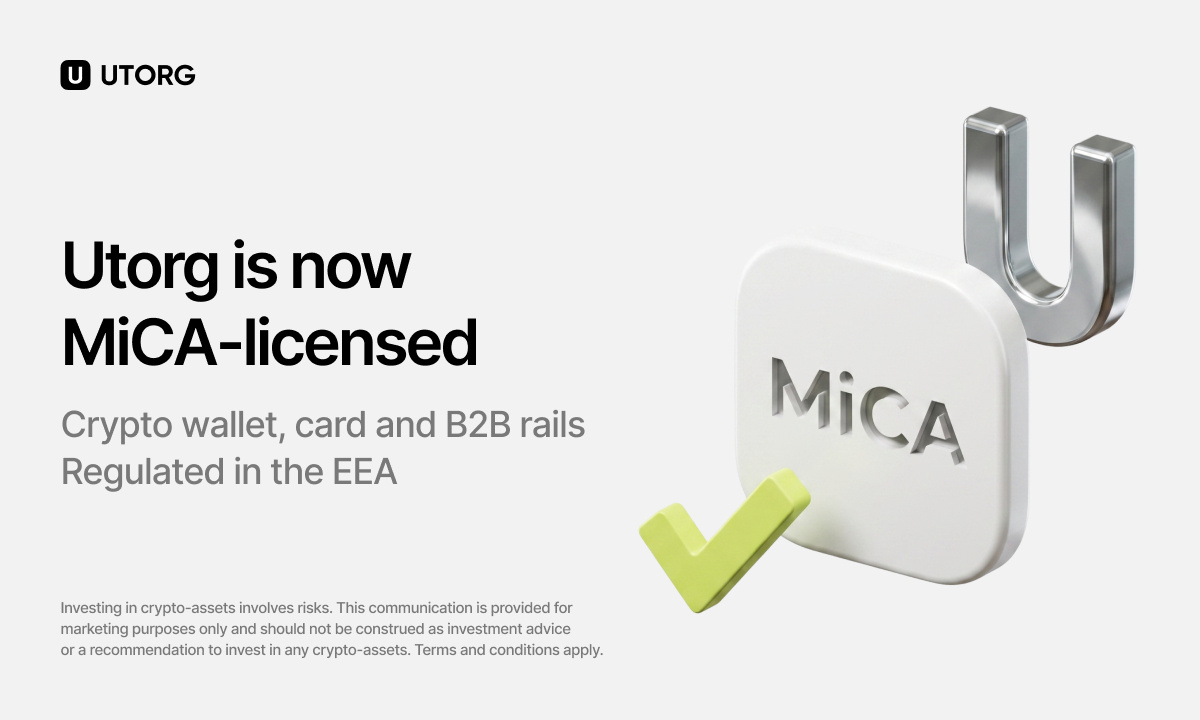
MiCA's Iron Curtain: Utorg Secures License as European Crypto Landscape Transforms
July 1st, 2026, marks a pivotal day in the European cryptocurrency landscape. As the Markets in Crypto-Assets (MiCA) regulation officially concludes its transitional period, ushering in an era of stringent oversight, only authorized providers can legally operate within the EU. Against this backdrop, Utorg, a crypto wallet and card platform built on institutional-grade infrastructure, has announced its full authorization under MiCA. This achievement is not merely a corporate milestone for Utorg; it serves as a powerful testament to MiCA's transformative impact, simultaneously opening doors for compliant entities while seemingly forcing a significant portion of the industry to reconsider its European presence.
The MiCA Deadline: A Regulatory Reckoning
The European Union's MiCA regulation has been a long time coming, designed to provide a comprehensive framework for crypto-asset service providers (CASPs) across all 27 member states. Its objectives are clear: to protect consumers, ensure market integrity, and foster financial stability within the burgeoning digital asset space. The July 1st deadline is the culmination of an extensive preparatory period, during which companies were expected to adapt their operations, systems, and legal structures to meet MiCA’s demanding standards. For many, this has proven to be an insurmountable hurdle.
The regulation mandates strict requirements on authorization, operational resilience, governance, capital adequacy, and consumer disclosure. It covers a broad spectrum of services, including the issuance of stablecoins, custody, exchange, and advisory services. The complexity and cost associated with achieving full compliance are substantial, demanding significant investment in legal, technical, and operational infrastructure. As a result, the industry has witnessed a stark division: those prepared to embrace the new regulatory reality, and those choosing to withdraw from the European market.
Utorg's Strategic Compliance: A Blueprint for Success
Utorg’s successful authorization under MiCA immediately positions it as a frontrunner in the newly regulated European crypto ecosystem. Their press release highlights their institutional-grade infrastructure, which likely provided a solid foundation for navigating the regulatory complexities. For Utorg, obtaining this license isn't just about legal operation; it's a profound strategic advantage. In a market where trust and security are paramount, particularly after years of volatile events and fraudulent schemes, being MiCA-compliant acts as a powerful differentiator. It signals reliability, transparency, and a commitment to robust consumer protection, attracting a more discerning and often institutional client base.
This achievement validates Utorg's long-term vision and investment in compliance. It sets them apart from the burgeoning number of platforms that will no longer be able to serve European customers, effectively shrinking the competitive landscape for compliant players. For users, Utorg's license offers reassurance that their assets are handled by an entity subject to the highest regulatory scrutiny, potentially fostering greater adoption among mainstream users and traditional financial institutions looking to enter the crypto space with reduced regulatory risk.
The European Exodus: A Double-Edged Sword
The source context explicitly mentions that the deadline "forces much of the industry out of Europe." This observation underscores the severe filtering effect of MiCA. While precise figures on the exodus are still emerging, anecdotal evidence and industry surveys have long predicted that many smaller players, startups, and even some established firms without deep pockets would find MiCA's compliance burden too heavy. For some, the decision might be to consolidate operations in less regulated jurisdictions; for others, it might mean shutting down European services entirely.
This exodus presents a double-edged sword for the European crypto market. On one hand, it eliminates bad actors and reduces market fragmentation, leading to a more secure and trustworthy environment. This 'flight to quality' could enhance Europe's reputation as a mature and reliable hub for digital assets. On the other hand, a significant reduction in the number of operational CASPs could stifle innovation, reduce competition, and potentially lead to higher service costs for consumers as the market consolidates around a smaller group of compliant providers. The question remains whether the benefits of enhanced security outweigh the potential costs of reduced market vibrancy and innovation.
What This Means for European Users and the Future of Crypto
For the average European crypto user, the post-July 1st landscape will be markedly different. The immediate benefit is enhanced protection. Users transacting with MiCA-compliant firms like Utorg can expect greater transparency, clearer terms of service, robust complaint handling mechanisms, and safeguards against market manipulation. This could lead to increased confidence and potentially wider adoption of crypto assets within the EU, moving beyond early adopters to a broader retail and institutional audience.
However, users might also experience fewer choices in platforms and services. Some niche or innovative services that don't fit neatly into MiCA's definitions or are too costly to bring into compliance might disappear from the European market. The long-term vision for Europe under MiCA is clear: to become a global leader in regulated digital finance. The success of this vision hinges on whether the framework can attract and retain innovative, compliant businesses while effectively weeding out malicious or unsustainable ventures. The next few years will be crucial in observing whether MiCA strikes the right balance between robust regulation and fostering innovation.
Utorg’s timely authorization serves as a beacon, illustrating that compliance is achievable and strategically beneficial. Their journey highlights a broader trend: the maturing of the crypto industry globally. As regulatory frameworks like MiCA come online, the landscape will continue to shift from a wild west frontier to a more structured, institutionalized financial sector. The companies that thrive will be those that, like Utorg, embrace responsible innovation within a clearly defined regulatory perimeter, ultimately building greater trust and enabling broader adoption of digital assets across the continent and beyond.