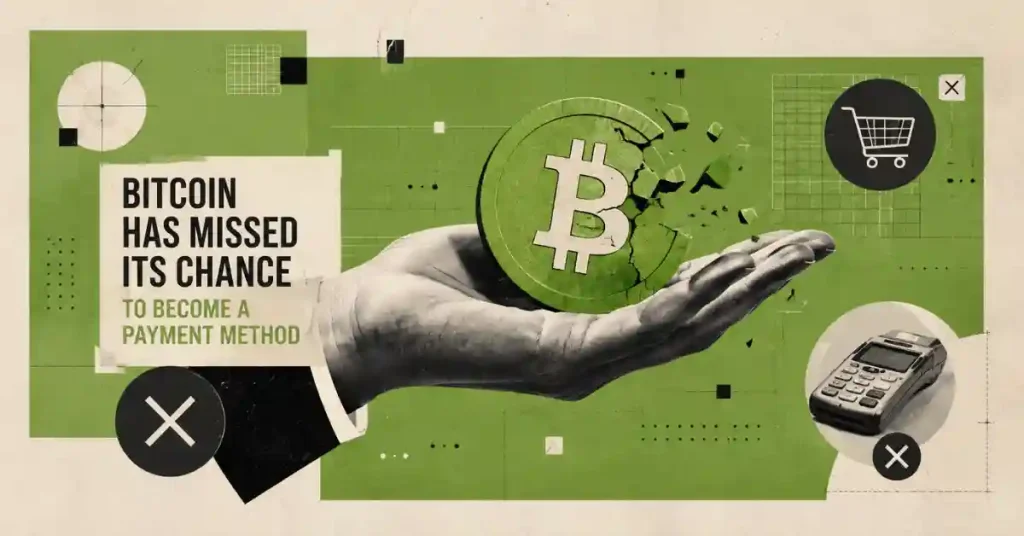
The Shifting Sands: Is Bitcoin's Payment Ambition a Relic of the Past?
Bitcoin, conceived in the wake of the 2008 financial crisis as 'peer-to-peer electronic cash,' has long grappled with its identity. While its meteoric rise has cemented its status as a revolutionary asset, its practicality as an everyday payment method has remained a contentious debate. This discourse has been reignited by a recent, potent declaration from Fred Thiel, CEO of Marathon Digital Holdings (MARA), one of the largest publicly traded Bitcoin mining companies. Thiel, whose company holds a substantial 36,300+ BTC, asserts unequivocally that Bitcoin has 'missed its chance' to become a dominant payment method, pointing to stablecoins as the superior alternative for daily transactions. This statement, coming from a significant figure deeply entrenched in the Bitcoin ecosystem, demands a thorough analysis of Bitcoin's evolving role and the future of digital payments.
The Original Vision vs. Market Realities
Satoshi Nakamoto’s whitepaper envisioned Bitcoin as a decentralized currency, free from the control of financial institutions, enabling cheap and fast transactions globally. For many early adopters and maximalists, this vision of Bitcoin as a ubiquitous medium of exchange remained paramount. However, the market has carved a different path. Bitcoin’s inherent design, particularly its base layer, struggles with the transaction throughput and speed required for widespread retail adoption. A typical Bitcoin transaction can take several minutes to confirm and often incurs fees that, while fluctuating, can be prohibitive for small purchases, especially during periods of high network congestion. More critically, its notorious price volatility – which, while attractive to speculators, makes it a nightmare for merchants and consumers alike – stands as the most significant hurdle. Imagine purchasing a coffee for $5, only for the Bitcoin equivalent to be worth $4.50 by the time the transaction confirms, or $5.50 a few hours later. Such instability undermines its utility as a reliable medium of exchange.
The Ascendancy of Stablecoins in Payments
Fred Thiel’s argument for stablecoins is compelling and mirrors the growing consensus within the broader financial and crypto industries. Stablecoins, like Tether (USDT) and USD Coin (USDC), are designed to maintain a stable value, typically pegged 1:1 with fiat currencies such as the US dollar. This stability eliminates the volatility risk inherent in Bitcoin, making them ideal for pricing goods, conducting transactions, and facilitating remittances. Their underlying blockchain technology allows for near-instantaneous settlement, often with significantly lower fees than traditional banking systems and, crucially, often lower than Bitcoin's base layer. Institutions and businesses are increasingly leveraging stablecoins for cross-border payments, treasury management, and even employee payroll, precisely because they combine the efficiency of blockchain with the predictability of fiat currency. This unique blend positions stablecoins as the pragmatic evolution of digital cash, effectively fulfilling the 'payment' role that Bitcoin has increasingly outgrown.
Bitcoin's Evolution: From Digital Cash to Digital Gold
While Bitcoin may be ceding the payments throne, it is by no means failing. Rather, it is consolidating its position as the preeminent 'digital gold' and a store of value. Its characteristics – scarcity (capped at 21 million coins), decentralization, immutability, and resistance to censorship – make it an attractive hedge against inflation and a safe haven asset, particularly in times of economic uncertainty. Institutional adoption, the emergence of Bitcoin ETFs, and its growing acceptance as a treasury asset by corporations further underscore this narrative. Investors are increasingly viewing Bitcoin not as a currency to spend, but as a long-term investment and a foundational layer of a new financial paradigm. In this context, its volatility is seen less as a hindrance to payments and more as a feature of a nascent, high-growth asset class with significant upside potential.
The Role of Layer-2 Solutions: Too Little, Too Late for Payments?
Proponents of Bitcoin as a payment method often point to Layer-2 scaling solutions, most notably the Lightning Network, as the answer to its transaction woes. The Lightning Network enables instant, near-free transactions by creating off-chain payment channels. While technically impressive and demonstrating significant potential for micro-payments, its adoption, user experience, and network effect still lag far behind the direct use of stablecoins. For the average consumer or merchant, the additional complexity of setting up and managing Lightning channels, coupled with its more niche integrations, presents a barrier to entry that stablecoins, with their simpler wallet-to-wallet transfers, largely bypass. While Lightning continues to develop, the window for Bitcoin to capture a significant share of mainstream retail payments through this route appears increasingly narrow, especially when weighed against the readily available and stable alternatives.
Conclusion: A Clarified Future for Bitcoin
Fred Thiel’s statement marks a crucial moment of clarity for the cryptocurrency industry. It signifies an acknowledgment that Bitcoin's greatest strength lies not in competing with fiat for daily transactions, but in serving as a foundational, censorship-resistant store of value and a beacon of monetary innovation. The 'digital cash' mantle, while noble in its inception, has largely been passed to stablecoins, which are better equipped to handle the demands of a high-volume, low-friction payment system. This evolution is not a defeat for Bitcoin but rather a refinement of its purpose. By embracing its role as digital gold, Bitcoin solidifies its enduring relevance and sets the stage for a future where it coexists with stablecoins – each fulfilling distinct, yet equally vital, functions within the burgeoning digital economy. The dream of Bitcoin as a global payment rail might be fading, but the reality of Bitcoin as a powerful new asset class is stronger than ever.
Featured News Partner: Coinpedia News