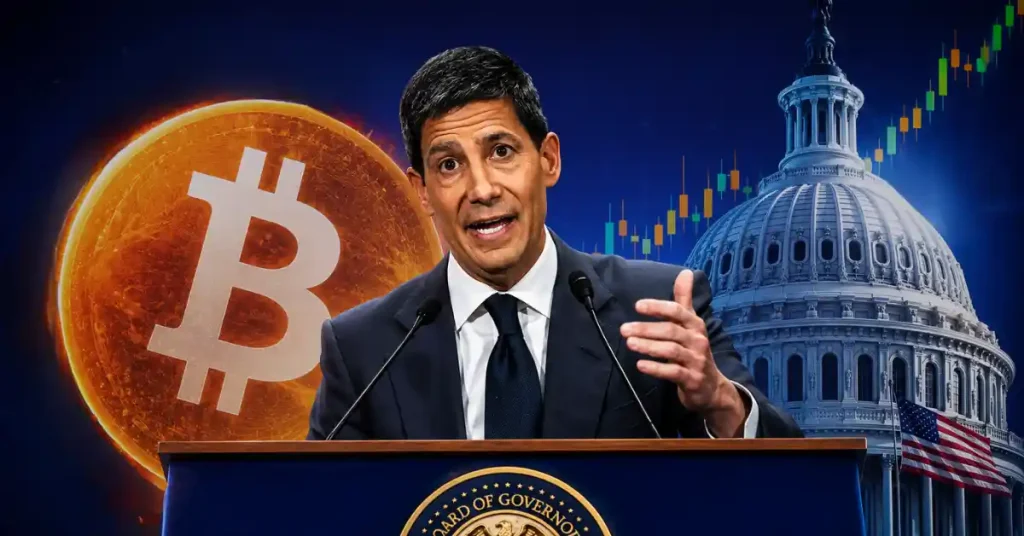
Bitcoin Bears React to Jackson Hole's Hawkish Roar
The cryptocurrency market, a landscape often characterized by its volatility, experienced a significant downturn in the past 24 hours. Bitcoin (BTC), the market's bellwether, led the descent with a 3.23% decline, pulling the overall crypto market cap down by 2.97%. Altcoins such as Ethereum (ETH) and XRP were not immune, falling 2.7% and 4.89% respectively. This swift market reaction is directly attributed to the hawkish outlook delivered at the highly anticipated Jackson Hole Economic Symposium, with specific attention drawn to remarks by former Federal Reserve Governor Kevin Warsh.
Understanding the Jackson Hole Symposium and Kevin Warsh's Influence
The Jackson Hole Economic Symposium is an annual gathering of central bankers, finance ministers, academics, and financial market participants from around the world, hosted by the Federal Reserve Bank of Kansas City. It serves as a crucial platform for policymakers to signal shifts in monetary policy, discuss global economic challenges, and offer insights into future financial directions. Historically, statements made at Jackson Hole have had profound impacts on global markets, shaping expectations for interest rates, inflation, and economic growth.
This year, the hawkish sentiment was notably amplified by the speech of Kevin Warsh. A former Governor of the Federal Reserve System from 2006 to 2011, Warsh is a highly respected figure known for his deep understanding of monetary policy and his often fiscally conservative and inflation-wary viewpoints. While not a current Fed official, his insights and interpretations of economic data carry significant weight among investors and analysts. His speech at Jackson Hole likely reinforced the market's perception of a determined and resolute Federal Reserve committed to its anti-inflationary stance, directly influencing investor sentiment towards risk assets like cryptocurrencies.
The Hawkish Stance Explained: Implications for Traditional Markets
A 'hawkish' central bank is one that prioritizes combating inflation, often at the expense of economic growth. This typically translates into a commitment to tight monetary policy, characterized by higher interest rates, quantitative tightening (reducing the money supply by shrinking the Fed's balance sheet), and a generally less accommodative stance. The primary goal is to cool down an overheating economy, curb demand, and bring inflation back to target levels.
For traditional financial markets, a hawkish outlook generally spells trouble. Higher interest rates increase the cost of borrowing for businesses and consumers, which can slow down economic activity and reduce corporate earnings. This makes equities less attractive compared to fixed-income investments, which begin to offer more competitive yields. Bond yields typically rise, reflecting the increased cost of money, and investors often rotate out of riskier assets into safer havens. The prospect of sustained monetary tightening also raises concerns about potential economic slowdowns or even recessions, further dampening investor enthusiasm.
Crypto's Vulnerability: Why Digital Assets Respond to Macro Shifts
The cryptocurrency market, once touted by some as entirely uncorrelated with traditional finance, has increasingly demonstrated its sensitivity to macroeconomic shifts, particularly those emanating from the Federal Reserve. Bitcoin, in particular, has evolved into a prominent risk-on asset, meaning it tends to perform well during periods of ample liquidity and low interest rates, but struggles when conditions tighten.
The inverse relationship between interest rates and speculative assets is a fundamental driver of this reaction. As the Fed signals higher interest rates, the opportunity cost of holding non-yielding assets like Bitcoin or other cryptocurrencies increases. Investors seeking returns can find more attractive yields in government bonds or high-interest savings accounts, making the allure of volatile digital assets diminish. This capital reallocation away from speculative investments directly impacts crypto valuations.
Liquidity Squeeze, Dollar Strength, and Market Psychology
Beyond interest rates, hawkish monetary policies also lead to a general reduction in global financial liquidity. Quantitative tightening, for example, directly siphons money out of the financial system. Less money flowing in the system means less capital available to chase speculative assets, inevitably putting downward pressure on prices across the board, including cryptocurrencies. Furthermore, a hawkish Federal Reserve often contributes to a stronger U.S. Dollar (DXY). Since most cryptocurrencies are priced against the dollar, a strengthening dollar can exert downward pressure on their valuations in dollar terms, effectively making them more expensive for international buyers and potentially prompting selling.
The psychological impact of such high-profile statements cannot be understated. While Kevin Warsh's remarks weren't an official Fed policy announcement, his stature and the context of Jackson Hole amplify market expectations regarding the Fed's future path. This can quickly shift collective investor sentiment from a risk-on attitude to one of fear, uncertainty, and doubt (FUD). In a market known for its reflexive nature, quick de-risking of portfolios can lead to cascading sell-offs, further exacerbating price declines. This ripple effect is particularly evident in altcoins like Ethereum and XRP, which often act as 'higher beta' assets, tending to amplify Bitcoin's movements in both directions.
The Broader Macro Picture and Analyst's Outlook
This market reaction is not an isolated incident but rather a continuation of a broader trend that has seen the crypto market increasingly converge with traditional finance. The Federal Reserve's aggressive tightening cycle, initiated to combat persistent inflation, has been a dominant force shaping asset prices throughout the year. The hawkish rhetoric from Jackson Hole, buttressed by recent economic data points such as inflation figures and employment reports, reinforces the expectation that the Fed is unlikely to pivot from its restrictive policy anytime soon, even at the risk of an economic slowdown.
As a Senior Crypto Analyst, my outlook suggests that investors must brace for continued volatility. The short-term trajectory of the crypto market will remain highly correlated with macroeconomic developments, particularly future pronouncements from the Federal Reserve, and key economic data releases such as the Consumer Price Index (CPI), Producer Price Index (PPI), and employment figures. While the underlying technological innovation, increasing institutional adoption, and expanding utility of digital assets continue to build a strong long-term thesis, the immediate headwinds from monetary policy are substantial.
For strategic investors, this period of consolidation and drawdown, though painful, could represent opportunities for dollar-cost averaging into fundamentally strong projects. However, caution is paramount, and traders should be particularly mindful of market sentiment and evolving macroeconomic indicators. The Jackson Hole symposium serves as yet another stark reminder that the crypto market, despite its unique characteristics, is now inextricably linked to the pulse of global economic policy.
Featured News Partner: Coinpedia News