From Silicon Peaks to Digital Gold: Is Capital Shifting Back to Bitcoin?
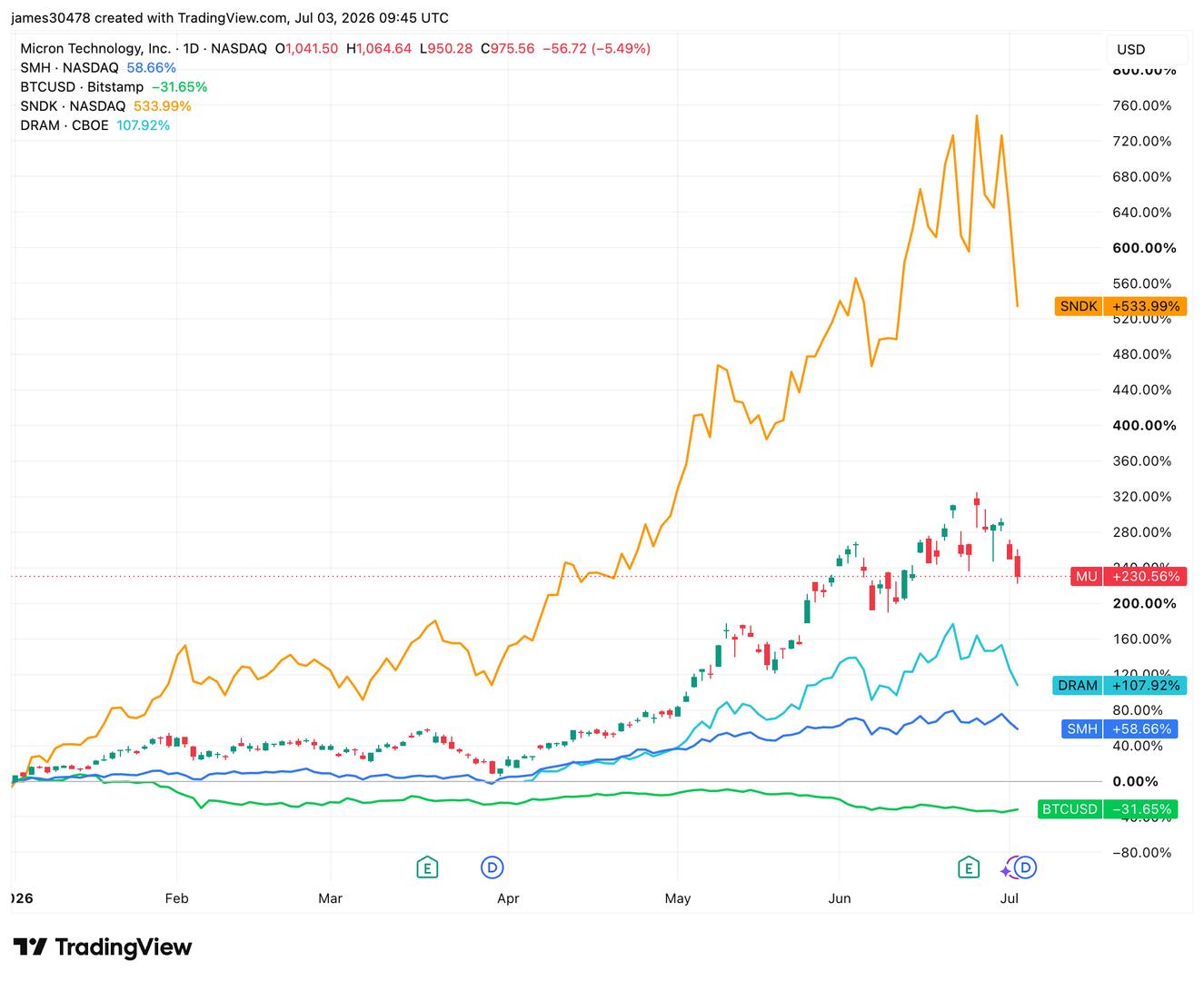
After a dominant run throughout 2026, where AI-tied memory and semiconductor stocks commanded unprecedented investor attention and capital, a distinct shift is now palpable in the markets. Recent observations indicate a deceleration in the momentum of these high-flying tech giants, coincident with a robust rebound in Bitcoin. This intriguing dynamic raises a pivotal question for senior crypto analysts and investors alike: are we witnessing a temporary market rotation, or a more fundamental reallocation of capital away from the once-unstoppable AI sector and back towards the resilient digital asset?
The Zenith of AI: A Look Back at 2026's Dominance
The year 2026 solidified AI's position as the uncontested king of capital markets. Fuelled by an insatiable demand for advanced processing power and memory solutions, companies at the forefront of AI chip manufacturing and development experienced exponential growth. The narrative was compelling: AI was not merely a technological advancement but a fundamental reshaping of industries, promising unparalleled efficiencies, innovation, and ultimately, profits. Investors poured billions into semiconductor stocks, viewing them as the foundational infrastructure for this new era. Valuations soared to dizzying heights, often justified by projected future earnings that seemed limitless. Every earnings call was a testament to expanding capacities, burgeoning order books, and strategic acquisitions designed to further entrench market dominance. The belief was widespread: AI’s growth trajectory was immune to traditional market fluctuations, cementing these stocks as a cornerstone of every diversified portfolio.
Fading Momentum: Why AI's Reign Might Be Softening
The current loss of momentum in the AI-tied memory and semiconductor sector, however, is not entirely unforeseen. Several factors could be contributing to this cooling period. Firstly, the sheer scale of the gains made throughout 2026 inevitably invites profit-taking. After such a parabolic ascent, even the most bullish investors might de-risk, locking in substantial returns. Secondly, valuation concerns have become increasingly prominent. Analysts have begun to question whether current stock prices accurately reflect sustainable growth rates, or if they have become disconnected from fundamental realities. Supply chain normalisation, following years of intense demand and capacity expansion, could also play a role, potentially leading to more competitive pricing and reduced margins in certain segments. Moreover, as any dominant sector grows, it often attracts greater regulatory scrutiny, which can introduce uncertainty. Finally, a broader shift in macroeconomic sentiment, perhaps related to evolving inflation outlooks or interest rate expectations, could be influencing investor appetite for high-growth, long-duration assets, making them less attractive compared to more stable or value-oriented plays. This confluence of factors suggests that while AI remains a transformative force, its market darling status might be undergoing a recalibration.
Bitcoin's Resurgence: A Digital Counterpoint
Concurrently with the softening in AI stocks, Bitcoin has staged an impressive comeback, recapturing investor interest and demonstrating renewed price strength. This rebound can be attributed to a confluence of factors that reinforce its unique position in the global financial landscape. As the euphoria surrounding AI equities begins to temper, investors may be seeking assets with different risk profiles or uncorrelated returns. Bitcoin, with its finite supply and decentralised nature, often appeals to those looking for a hedge against traditional market volatility and inflation – a 'digital gold' narrative that gains traction during periods of economic uncertainty or equity market consolidation. Continued institutional adoption, further solidified by the increasing popularity of spot Bitcoin ETFs, has also provided significant buying pressure and lending greater legitimacy to the asset class. Furthermore, the inherent halving cycle, even in a post-2026 context, continues to underpin a long-term bullish outlook by reinforcing scarcity. As investors look beyond overstretched tech valuations, Bitcoin offers an alternative growth story, one rooted in its technological innovation, expanding utility within decentralised finance, and growing acceptance as a global monetary asset.
The Capital Migration: A Realignment of Portfolios?
The central question remains: Is capital truly migrating from AI stocks to Bitcoin? While it's premature to declare a definitive, wholesale shift, the evidence points towards a significant rotation. Investors are constantly seeking the optimal balance of risk and reward, and when one sector appears to be peaking, capital naturally flows to areas perceived to offer better future prospects or safer havens. This movement could represent a strategic reallocation, where portfolios, perhaps overweight in tech following 2026, are being rebalanced to include assets like Bitcoin that offer diversification benefits and a distinct growth narrative. Bitcoin's increasing maturity as an asset class means it is now viewed by a broader spectrum of institutional and retail investors as a legitimate component of a diversified portfolio, rather than purely a speculative play. This is not to say AI’s long-term promise is diminished, but rather that market participants are becoming more discerning, seeking value and potential in areas that haven’t experienced the same parabolic appreciation. The capital shift hypothesis posits that smart money, having reaped profits from AI, is now scouting for the next major opportunity or a more robust store of value.
Implications for the Forward-Thinking Investor
For the forward-thinking investor, these market dynamics underscore several crucial considerations. Firstly, the importance of diversification cannot be overstated. Relying too heavily on any single sector, no matter how dominant, exposes portfolios to undue risk. The current environment highlights the value of assets like Bitcoin that possess different fundamental drivers and market cycles. Secondly, understanding the evolving role of Bitcoin is paramount. It is no longer just a fringe asset; its increasing liquidity, regulatory clarity, and institutional integration position it as a serious contender for capital allocation, offering both speculative growth potential and an emergent store of value proposition. Finally, while the AI revolution will undoubtedly continue, its investment landscape will likely mature, necessitating a more nuanced approach than the broad-brush enthusiasm of 2026. This period of transition encourages investors to reassess their strategies, seeking equilibrium between high-growth technology and alternative assets that can provide resilience and new avenues for appreciation. The market is dynamic, and the current shift from silicon peaks to digital gold may well herald a new chapter in capital allocation.