Ether's Golden Ascent: Why ETH is Crushing Bitcoin and What's Next for the Crypto Giant
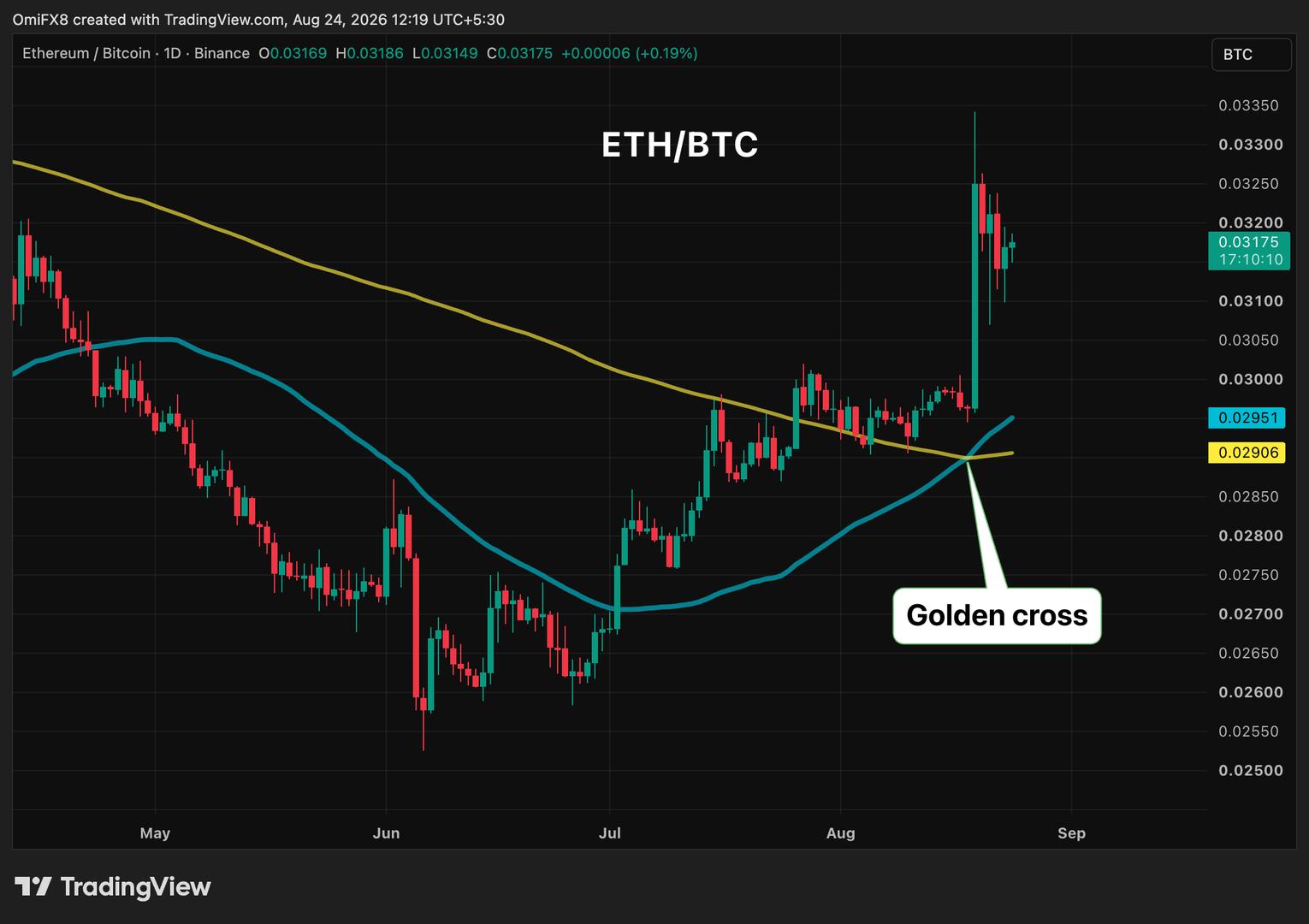
In the ever-evolving crypto landscape, market dynamics between the two largest assets, Bitcoin (BTC) and Ether (ETH), are under constant scrutiny. Recently, a significant shift has captured the attention of analysts: Ether's impressive outperformance against Bitcoin. This isn't just about ETH's USD price gains, but its relative strength shown by the ETH/BTC ratio. A crucial technical signal, the "golden cross," has just formed on this ratio, traditionally hinting at extended bullish momentum for Ether relative to the market's pioneer cryptocurrency. As a Senior Crypto Analyst, I believe this development signals a potentially prolonged period where Ether could lead the charge, driven by a powerful confluence of technical indicators and robust fundamental developments within its ecosystem.
The Significance of the ETH/BTC Ratio
For seasoned crypto investors, the ETH/BTC ratio is more than just a data point; it's a barometer for market cycles and the health of the broader altcoin market. When this ratio trends upwards, it suggests capital is flowing from Bitcoin into Ether, often preceding or accompanying an "altcoin season" where other alternative cryptocurrencies also see significant gains. Bitcoin typically acts as the market's initial driver, attracting institutional capital and setting the general market direction. However, once Bitcoin establishes a strong foundation and consolidates, savvy investors often reallocate profits into high-potential altcoins like Ether, seeking higher percentage returns. An ascending ETH/BTC ratio thus implies growing confidence in Ethereum's ecosystem and its potential to capture a larger share of the total crypto market capitalization. This shift can dictate portfolio strategies for months to come, emphasizing the need to understand its implications.
Deconstructing the "Golden Cross" on the ETH/BTC Chart
The "golden cross" is a highly watched technical pattern in financial markets. It occurs when a short-term moving average (commonly the 50-day Simple Moving Average or SMA) crosses above a long-term moving average (typically the 200-day SMA). For the ETH/BTC ratio, this specific cross indicates that Ether's recent performance against Bitcoin has significantly improved over its longer-term trend. The 50-day SMA moving above the 200-day SMA suggests that bullish momentum is accelerating and gaining sustained traction. Historically, golden crosses are viewed as strong buy signals, often preceding substantial uptrends. While no indicator is infallible, the convergence of these two key moving averages on such a critical pair as ETH/BTC lends significant weight to the bullish argument for Ether's continued outperformance. It reflects a paradigm shift in investor sentiment and positioning, moving from a BTC-centric focus to one that increasingly values Ether's unique attributes and growth potential.
Fundamental Drivers Fueling Ether's Ascent
While technicals provide valuable insights into market sentiment, fundamental strength is what sustains long-term growth. Ether's recent bullish momentum is underpinned by several compelling factors:
1. Ecosystem Dominance: Ethereum remains the undisputed leader in smart contract platforms, hosting the vast majority of DeFi protocols, NFT marketplaces, and critical Web3 infrastructure. Its robust developer community and network effects are unparalleled.
2. Upcoming Protocol Upgrades: The network is continually evolving. Following the successful Dencun upgrade (which introduced proto-danksharding, significantly reducing Layer 2 transaction costs), future upgrades like Pectra are on the horizon. These enhancements improve scalability, efficiency, and security, making Ethereum more attractive for both users and developers.
3. Spot Ether ETFs: The prospect of Spot Ether Exchange-Traded Funds in the U.S., following the SEC's approval of Bitcoin ETFs, represents a potential game-changer. Regulatory clarity and easy access for traditional investors could unlock a new wave of institutional capital, similar to what Bitcoin experienced.
4. Deflationary Mechanics: Post-Merge and EIP-1559, Ether has become a deflationary asset under certain network conditions. A portion of transaction fees is burned, reducing the total supply over time and increasing the scarcity of ETH, which naturally supports its price.
These fundamental tailwinds provide a strong narrative for Ether's long-term value proposition, reinforcing the signals from the technical charts.
Bitcoin's Stability Paves the Way
It’s crucial to understand that Ether's outperformance against Bitcoin doesn't necessarily mean a decline in Bitcoin's absolute value. In fact, Bitcoin's recent stability and impressive rally, fueled by its own spot ETFs and the halving event, often create the ideal conditions for altcoins to thrive. When Bitcoin establishes a strong base and shows signs of consolidation after a significant pump, market participants often look for opportunities in assets with higher growth potential, leading to capital rotation. Bitcoin's role as digital gold and a store of value attracts the initial institutional wave, de-risking the broader market. Once this initial phase matures, the focus shifts to innovation and utility, areas where Ethereum shines. Thus, Bitcoin's strength can be seen as a necessary precursor, setting the stage for Ether to capture the spotlight.
Navigating Potential Risks and Caveats
While the outlook for Ether appears robust, it's imperative for investors to approach the market with a balanced perspective and acknowledge potential risks. Technical indicators like the golden cross, while powerful, are not guarantees and can sometimes produce false signals in volatile markets. Macroeconomic headwinds, such as unexpected shifts in interest rates or global economic downturns, could dampen overall crypto market sentiment. Regulatory uncertainties, particularly concerning the classification of Ether by various global bodies, also pose a risk. Furthermore, while Ethereum dominates, competition from other Layer 1 blockchains (e.g., Solana, Avalanche) or Layer 2 solutions that bypass Ethereum's mainnet could present challenges. Investors should conduct thorough due diligence, manage risk prudently, and monitor both on-chain metrics and broader market developments.
Conclusion
The recent formation of a golden cross on the ETH/BTC ratio is a compelling technical event, suggesting that Ether's period of outperformance against Bitcoin is likely to continue and potentially strengthen. This technical signal is not an isolated incident but rather a confluence of factors, including Ethereum's unparalleled ecosystem growth, ongoing protocol enhancements, the looming prospect of spot Ether ETFs, and its deflationary tokenomics. While Bitcoin has successfully paved the way with its own institutional adoption, the spotlight is now increasingly turning towards Ether's utility, innovation, and potential for greater relative returns. As we move further into this market cycle, the ETH/BTC ratio will be a critical indicator to watch, potentially signaling a significant rotation of capital and a reassertion of Ether's fundamental strength in the evolving digital asset landscape. Investors should remain attentive to these dynamics, positioning themselves to capitalize on what could be a golden era for Ether.