Ethereum's Optimistic Horizon Darkens: The $2.1k Crossroads
The crypto market, ever-fickle and prone to rapid sentiment shifts, is once again putting Ethereum (ETH) under the microscope. Trading around the critical $2.1k mark, what initially seemed like a healthy, cyclical pullback is now revealing itself as a far more structural breakdown, shattering months of carefully built optimism. The narrative of resilience and steady growth, a staple since the February bottom, is facing its sternest test yet, as key technical and fundamental pillars begin to crumble.
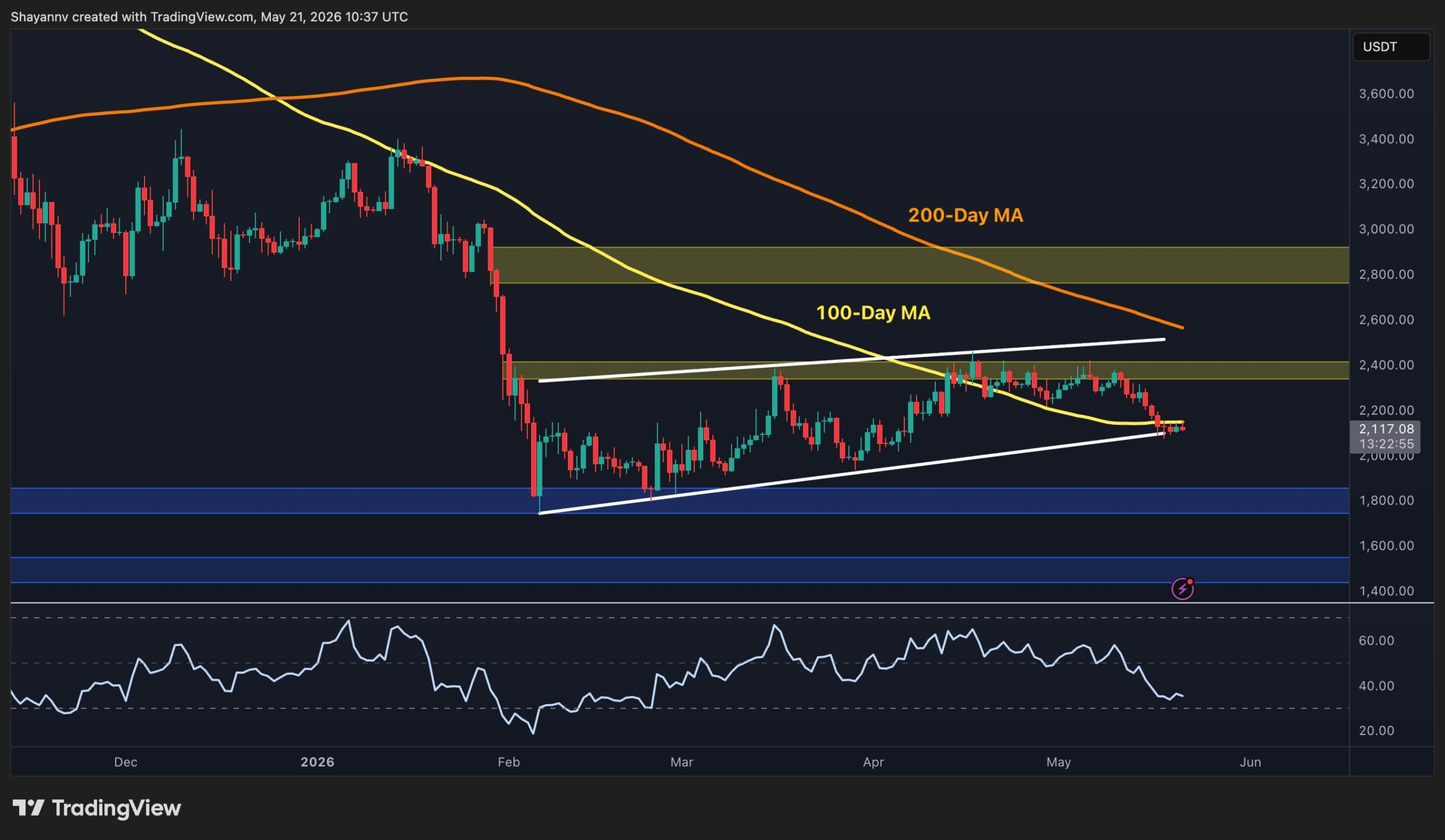
For nearly three months, Ethereum's price action found solace and structural integrity within a well-defined ascending channel. This pattern, characterized by consistent higher highs and higher lows, served as the bedrock for every bullish argument, providing a clear pathway for sustained upward momentum. It was a visual representation of investor confidence, a steady climb fueled by a combination of fundamental progress and an increasingly robust institutional interest. However, the current price action is delivering a stark warning: this critical structural backbone is now breaking down, signaling a profound shift in market dynamics that demands immediate attention from traders and investors alike.
The Ascending Channel Breach: A Technical Demolition
The most immediate and concerning development is the decisive breach of the ascending channel's lower trendline. This is not merely a flicker of volatility; it's a technical event with significant implications. An ascending channel represents a consistent trend of accumulation and higher valuation over time. Its breakdown to the downside signals that the buying pressure that once defined this upward trajectory has dissipated, and sellers are now gaining the upper hand with conviction.
Historically, such breaches often precede accelerated downside movements. With the $2.1k level already struggling to hold, the immediate focus shifts to subsequent support zones. The psychological $2,000 level is the first line of defense, but given the nature of this breakdown, its resilience is questionable. A more significant support lies around $1,900, a level that previously offered strong resistance before being overcome. Should this fail, the path opens up towards $1,800, and in a more extended capitulation scenario, a retest of the $1,500 region – a critical former resistance turned support – cannot be ruled out. Volume accompanying this breakdown will be crucial to confirm its validity; higher selling volume suggests a more forceful and conviction-driven move.
Furthermore, traditional technical indicators like the Relative Strength Index (RSI) and Moving Average Convergence Divergence (MACD) are likely to be confirming this bearish shift. A plummeting RSI below the 50-mark, potentially heading towards oversold territory, coupled with a bearish cross on the MACD, would further validate the severity of the current price action and indicate sustained downward momentum rather than a temporary dip.
The Vanishing Institutional Bid: A Fundamental Shift
Beyond the charts, a significant driver behind Ethereum's previous recovery was the robust US institutional bid. This influx of capital, driven by growing interest in diversified crypto exposure, the anticipation of future regulatory clarity, and the long-term potential of the Ethereum ecosystem, provided a consistent demand floor. Major investment funds and high-net-worth individuals were accumulating ETH, contributing to its upward trajectory and absorbing selling pressure.
However, the current price action strongly suggests a weakening, if not outright vanishing, of this crucial institutional support. Several factors could be contributing to this retreat. Macroeconomic uncertainties, including persistent inflation concerns leading to hawkish stances from the Federal Reserve, are causing a broader shift in risk appetite. Institutions are often the first to de-risk portfolios in such environments, moving away from volatile assets like cryptocurrencies. Furthermore, a lack of immediate catalysts for further upside, coupled with potential profit-taking after significant gains since the February bottom, could be prompting institutions to sit on the sidelines or even liquidate positions.
Regulatory ambiguity in the US also continues to cast a shadow. While progress is being made on some fronts, the broader lack of a clear framework for crypto assets can make institutional investment a higher-risk proposition, especially when compared to more regulated traditional assets. The absence of this powerful buying force leaves Ethereum more vulnerable to selling pressure and retail market sentiment, which tends to be more volatile.
Broader Market Dynamics and Ethereum's Unique Pressures
Ethereum's fate is rarely isolated. The broader crypto market sentiment, often dictated by Bitcoin's movements, plays a pivotal role. A potential increase in Bitcoin dominance, coupled with a general risk-off environment across the entire crypto asset class, could further exacerbate outflows from altcoins like Ethereum. If Bitcoin struggles, altcoins typically suffer more pronounced declines.
While Ethereum's fundamental roadmap, including the upcoming Dencun upgrade, remains compelling for long-term holders, short-term price action often discounts such positives amidst market pessimism. The Dencun upgrade aims to significantly reduce transaction costs for Layer 2 networks and improve scalability, a long-term positive. However, market sentiment, especially in the face of a technical breakdown, tends to prioritize immediate price action over future potential. Competing Layer 1 solutions also continue to innovate, potentially drawing some developer and user attention, although Ethereum's network effect remains unparalleled.
Navigating the Storm: What's Next for Ethereum?
The immediate outlook for Ethereum appears challenging. Traders and investors should prepare for increased volatility and the potential for further downside as the market digests this structural breakdown. Reclaiming the ascending channel would require a swift and powerful reversal, a scenario that seems less likely in the immediate term without a significant, unforeseen bullish catalyst. Instead, a period of consolidation at lower levels might be necessary to build a new base of support and re-establish buyer confidence.
For those holding Ethereum, risk management becomes paramount. Re-evaluating stop-loss levels, considering hedging strategies, or simply taking a step back to observe market behavior might be prudent. New entries should be approached with extreme caution, waiting for clear signs of stabilization or a reversal of the bearish trend. The previous narrative of easy gains and consistent upward momentum has been shattered, replaced by a period requiring heightened vigilance and a data-driven approach.
Conclusion: A Call for Prudence Amidst Uncertainty
The current breakdown in Ethereum's price is a stark reminder of the crypto market's unforgiving nature. What started as cautious optimism has given way to legitimate technical concerns, reinforced by a shifting institutional landscape. While Ethereum's long-term vision and technological potential remain robust, the short-to-medium term demands prudence, vigilance, and a critical re-evaluation of previous bullish biases. The days of simply pulling back are over; Ethereum is in a fight to hold its ground, and the coming weeks will be crucial in determining its next significant move. Investors must adapt to this new reality, prioritizing capital preservation and a realistic assessment of market conditions.