The $97 Million Quake: Crypto Billionaires Fuel Reform UK
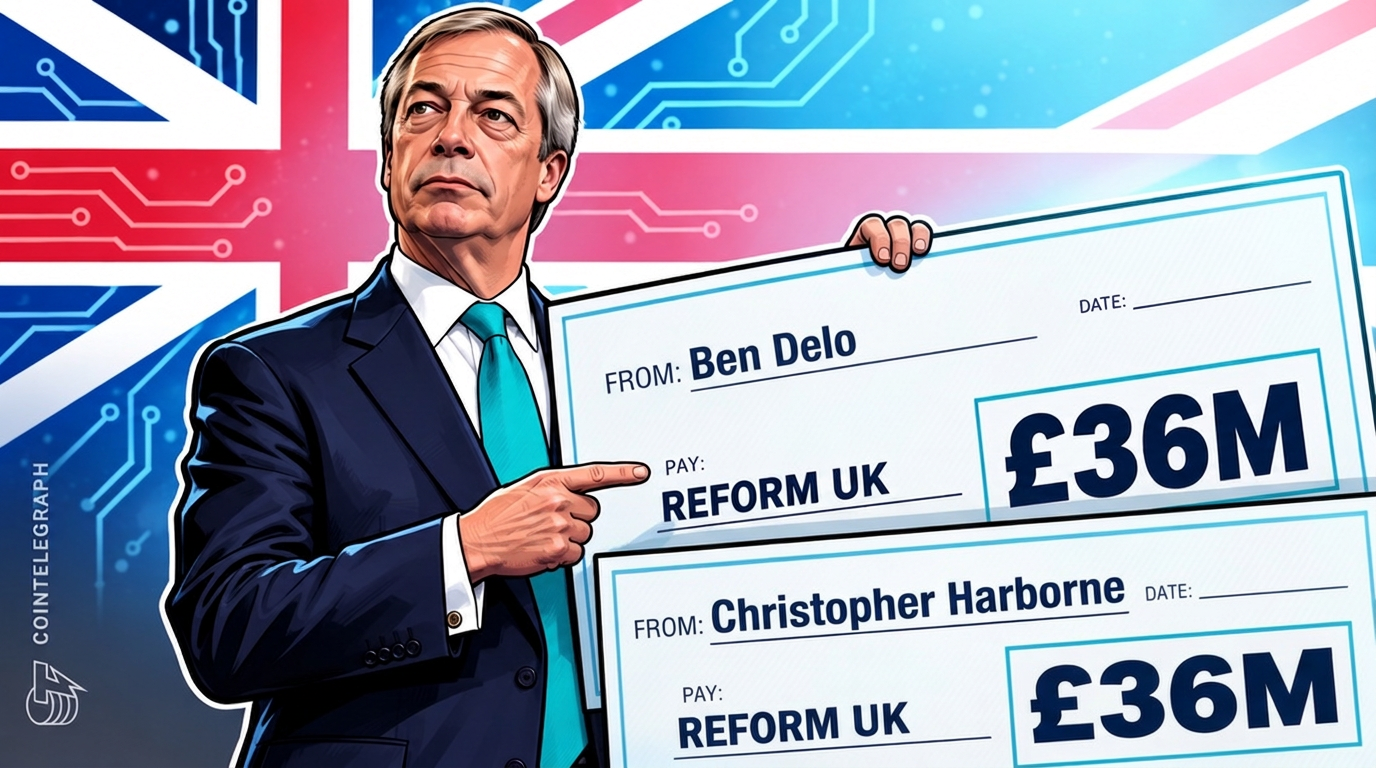
In a move that has sent reverberations through both the political and financial spheres, Nigel Farage’s Reform UK party has received an unprecedented financial injection totaling approximately $97 million from two prominent figures in the cryptocurrency world: Ben Delo, co-founder of the pioneering crypto derivatives exchange BitMEX, and Christopher Harborne, another crypto billionaire whose profile, while less public, clearly denotes significant wealth and influence. This colossal sum, with Delo donating nearly $50 million and Harborne matching it a day later, is not merely a political donation; it represents a watershed moment for the digital asset industry, signaling its growing intent to directly shape the political and regulatory landscape, particularly in a major global financial hub like the United Kingdom.
Decoding the Donors: A Glimpse into Crypto's Elite
The identities of the donors offer crucial context. Ben Delo is a name synonymous with early crypto success and, subsequently, regulatory scrutiny. As a co-founder of BitMEX, he was at the forefront of the industry's rapid growth, building one of the world's largest crypto derivatives platforms. However, this ascent was not without controversy. Delo, along with other BitMEX executives, faced significant legal challenges from U.S. regulators, including the Commodity Futures Trading Commission (CFTC) and the Department of Justice (DOJ), concerning failures to implement adequate anti-money laundering (AML) and know-your-customer (KYC) programs. These cases culminated in substantial settlements and personal convictions, underscoring the ongoing tension between rapid innovation and regulatory compliance in the crypto space.
Given this history, Delo's motivation for such a significant political contribution could be multifaceted. It might be interpreted as an attempt to foster a more permissive or 'innovation-friendly' regulatory environment, a desire to influence policies that directly impact the crypto sector's operational freedom, or perhaps a philosophical alignment with a party advocating for reduced state intervention. Christopher Harborne, while less publicly known in crypto circles, matching Delo's near $50 million donation confirms his status as a substantial player within the digital asset economy, suggesting a similar strategic rationale or ideological bent.
Reform UK: A Receptive Canvas for Crypto Ideals?
Nigel Farage's Reform UK party, often characterized by its populist, libertarian-leaning, and anti-establishment rhetoric, presents an intriguing recipient for such large-scale crypto funding. The party’s platform frequently champions lower taxes, reduced government spending, and less bureaucratic oversight – principles that resonate strongly with certain segments of the crypto community, particularly those who value decentralization, individual sovereignty, and skepticism of traditional financial institutions. For individuals who have amassed vast wealth outside conventional financial systems, a political party advocating for minimal state interference could be seen as an ideal vehicle to protect their interests and promote a regulatory framework conducive to further crypto innovation and wealth generation.
This alignment is more than just financial; it hints at a deeper philosophical convergence. Many in crypto envision a future less constrained by legacy financial institutions and government control. Reform UK's appeal lies in its promise to disrupt the status quo, which could be highly attractive to those who made their fortunes challenging it.
The Strategic Play: Influencing the Regulatory Tapestry
The UK is currently navigating a complex post-Brexit regulatory landscape, particularly concerning digital assets. While the government has expressed ambitions to become a global crypto hub, the path to achieving this is fraught with debates over consumer protection, market integrity, and innovation. Against this backdrop, the $97 million donation can be viewed as a highly strategic investment. It signals that the crypto industry is ready to leverage its considerable capital to directly influence policy direction, potentially steering the UK away from overly stringent oversight that might stifle innovation or impose prohibitive costs on crypto businesses.
This move is a bold declaration of intent: crypto wealth is not just for speculative investment but for active political engagement. It demonstrates a desire to move beyond merely reacting to regulatory proposals and instead proactively shape the legislative agenda, ensuring that the interests of the digital asset sector are not just heard, but are a powerful voice at the highest echelons of government.
Implications for the Crypto Industry: Legitimacy, Scrutiny, and Backlash
The implications of these donations for the broader crypto industry are profound and multifaceted. On one hand, it could be seen as a significant step towards legitimizing crypto wealth and its role in mainstream politics. It demonstrates that digital asset fortunes are real, substantial, and capable of competing with traditional finance in terms of political influence, potentially paving the way for greater acceptance and integration.
On the other hand, such large, high-profile donations invariably invite intense scrutiny. Questions about the source of funds, potential conflicts of interest, and the perceived attempt to buy political favor could arise, fueling narratives of 'dark money' or regulatory arbitrage. This might inadvertently tarnish crypto's image among the general public and mainstream politicians, potentially leading to increased demands for stricter transparency and oversight, rather than the lighter touch some donors might hope for. Governments and existing financial institutions, wary of unregulated influence, might respond by accelerating efforts to impose even tighter controls on the digital asset sector.
Furthermore, this event could solidify the emergence of an informal 'crypto lobby' in UK politics. While not a formally registered lobbying group, the coordinated, substantial funding from crypto billionaires signifies a powerful and wealthy bloc within the digital asset space that is now directly engaging with political parties. This development echoes past instances of crypto figures engaging in political donations, such as Sam Bankman-Fried's extensive contributions in the US, albeit with a dramatically different and ultimately catastrophic outcome for SBF. The UK's handling of these donations will set a crucial precedent for how other nations might approach the intersection of crypto wealth and political power.
Conclusion: A New Era of Political Engagement for Crypto
The $97 million injection into Reform UK marks a pivotal moment for the crypto industry. It forces a critical conversation about the evolving role of digital asset wealth in politics, the motivations driving such colossal donations, and the future regulatory environment for an industry constantly straddling innovation and oversight. As crypto matures, its financial muscle is undeniable. The challenge now for the industry is to navigate this new era of political engagement carefully, balancing its aspirations for growth and innovation with the imperative for transparency, ethical conduct, and public trust, especially as its influence on global governance becomes increasingly pronounced.