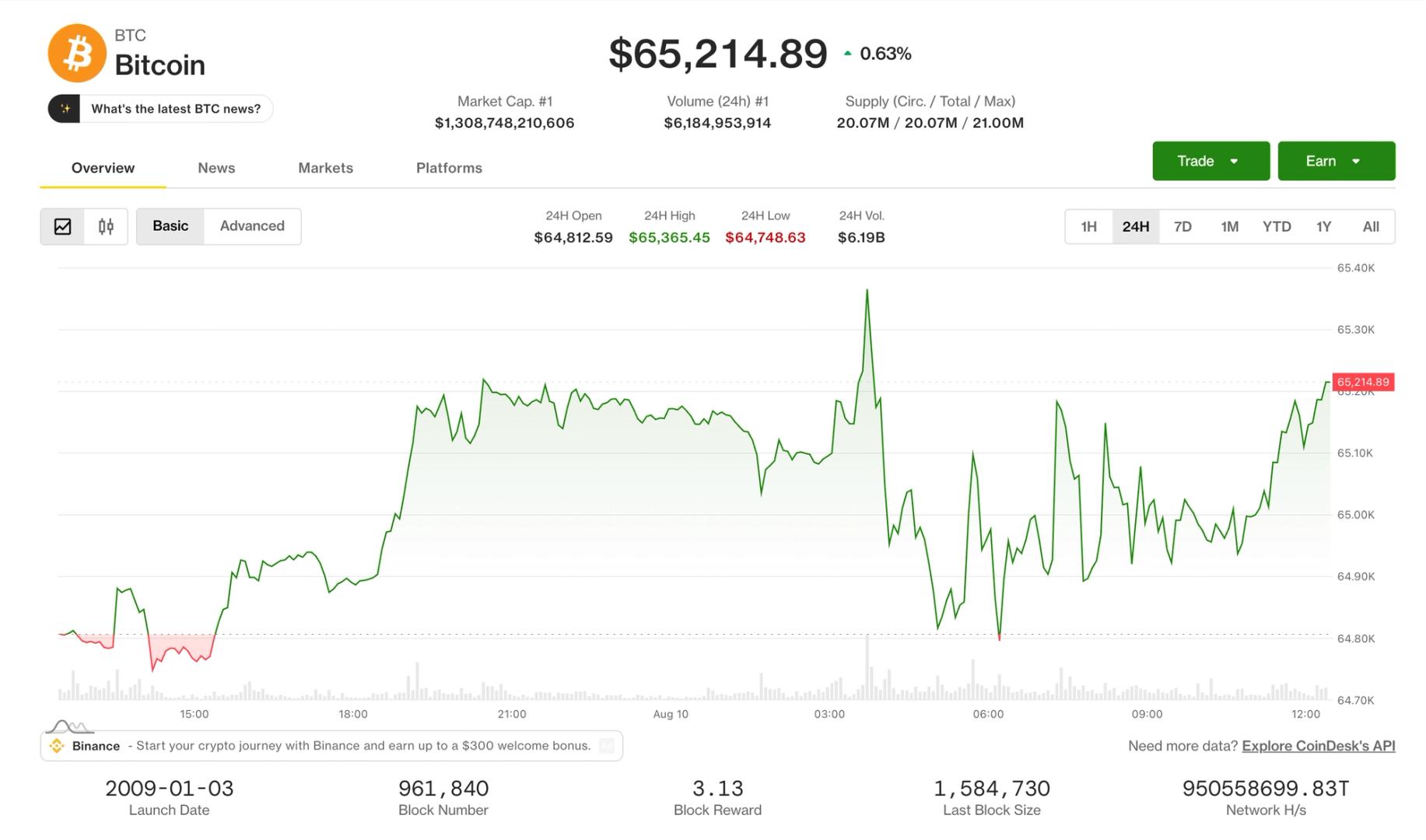
Bitcoin's Resilience: A Testament to Market Fundamentals Over Regulatory Gridlock
In a fascinating display of market strength and evolving maturity, Bitcoin has defied conventional wisdom, surging comfortably above the $65,000 mark even as the U.S. Senate opted to punt the crucial CLARITY Act until the fall. This seemingly paradoxical movement – a rally in the face of continued regulatory uncertainty – underscores a powerful narrative shift: the crypto market's increasing ability to find its footing through robust fundamental drivers, rather than being solely tethered to the whims of Washington D.C.
The CLARITY Act, a bipartisan effort aimed at providing much-needed regulatory definitions for digital assets, remains in legislative limbo. Its postponement before the Senate’s recess means the industry continues to operate under a patchwork of ambiguous guidelines, with the perennial debate over whether various crypto assets constitute securities or commodities lingering unresolved. Historically, such legislative delays or negative regulatory signals have often triggered market tremors. Yet, Bitcoin's recent performance suggests a growing decoupling, where the weight of institutional adoption and macroeconomic tailwinds now overshadows – or at least mitigates – the immediate impact of U.S. regulatory inertia.
The Unyielding Power of ETF Inflows: Fueling Institutional Adoption
At the heart of Bitcoin’s current upward momentum are the relentless and substantial inflows into spot Bitcoin Exchange-Traded Funds (ETFs). Since their launch in January, these investment vehicles have fundamentally altered the landscape of Bitcoin accessibility, providing a regulated, familiar conduit for institutional investors and traditional finance players to gain exposure to the digital asset. Unlike the retail-driven speculative surges of past cycles, the current demand is characterized by steady, consistent accumulation from large-scale entities.
Data from various on-chain analytics firms and fund trackers consistently show net positive inflows into the suite of U.S. spot Bitcoin ETFs. While there have been sporadic days of outflows, particularly from the converted Grayscale Bitcoin Trust (GBTC), these have largely been dwarfed by the significant purchases from new entrants like BlackRock's IBIT and Fidelity's FBTC. These inflows represent fresh capital entering the ecosystem, validating Bitcoin's position as a legitimate, investable asset class within diversified portfolios. The cumulative effect of this institutional buying acts as a powerful demand shock, absorbing available supply and exerting upward pressure on price. It signals a maturation of Bitcoin's market structure, moving beyond niche speculation towards mainstream financial integration, a trend far more impactful than a delayed Senate vote.
Macroeconomic Tailwinds: A Softer Dollar and Flight to Alternatives
Beyond the structural shift brought by ETFs, a significant macroeconomic factor contributing to Bitcoin's resilience is the softening U.S. Dollar. The Dollar Index (DXY), which measures the dollar's value against a basket of major currencies, has shown signs of weakness amid shifting expectations regarding the Federal Reserve's monetary policy. Speculation of potential interest rate cuts later in the year, coupled with persistent inflation concerns and global economic uncertainties, tends to diminish the appeal of holding dollar-denominated assets and often prompts a flight towards alternative stores of value.
Historically, Bitcoin has often exhibited an inverse correlation with the U.S. dollar, functioning as a perceived hedge against inflation and a beneficiary of looser monetary conditions. As investors seek to preserve purchasing power or diversify away from fiat currencies, assets like Bitcoin and gold tend to become more attractive. The current macro environment, characterized by central banks worldwide grappling with inflation and economic growth, creates a conducive backdrop for digital assets. This broader macroeconomic narrative provides a powerful and fundamental tailwind that transcends specific U.S. legislative actions, positioning Bitcoin as a global asset responsive to global economic forces rather than purely local political developments.
The CLARITY Act Delay: A Mitigated Impact
The Senate's decision to push back the CLARITY Act until the fall, while frustrating for those seeking regulatory certainty, has evidently not been the market disruptor many might have anticipated. This suggests a few possibilities. Firstly, the market may have already priced in a certain level of U.S. regulatory sluggishness, viewing delays as par for the course rather than a sudden negative shock. Secondly, the powerful positive drivers – ETF demand and macro trends – are simply too strong to be overshadowed by domestic legislative gridlock alone.
Furthermore, some in the industry might even view a delay as a temporary reprieve, buying more time to refine arguments and potentially prevent a rushed or unfavorable regulatory framework. The Act aims to clarify whether digital assets fall under the jurisdiction of the Securities and Exchange Commission (SEC) or the Commodity Futures Trading Commission (CFTC), a distinction that carries significant implications for how products are launched, traded, and supervised. While clarity is ultimately desired, the immediate absence of a definitive ruling may be seen as maintaining the status quo, which the market appears robust enough to navigate, at least for now.
Outlook: A More Mature Market Navigating Global Currents
Bitcoin's performance above $65,000, despite the CLARITY Act's delay, paints a picture of a more resilient and mature market. The focus has undeniably shifted from speculative retail frenzy and U.S.-centric regulatory FUD to sustained institutional adoption and broader macroeconomic influences. While regulatory clarity in the U.S. remains important for long-term growth and innovation within its borders, the current rally highlights Bitcoin's growing independence and its increasingly global appeal as a legitimate asset class.
Going forward, investors should continue to monitor ETF inflow trends, global macroeconomic indicators, and central bank policies. While U.S. regulatory developments will eventually reclaim attention, especially if clearer frameworks emerge, for now, the market appears to be telling us that the fundamental drivers of demand and the broader economic landscape are the true architects of Bitcoin's price trajectory. The digital asset ecosystem is evolving beyond being purely a U.S. regulatory play, becoming a significant force in the global financial landscape in its own right.