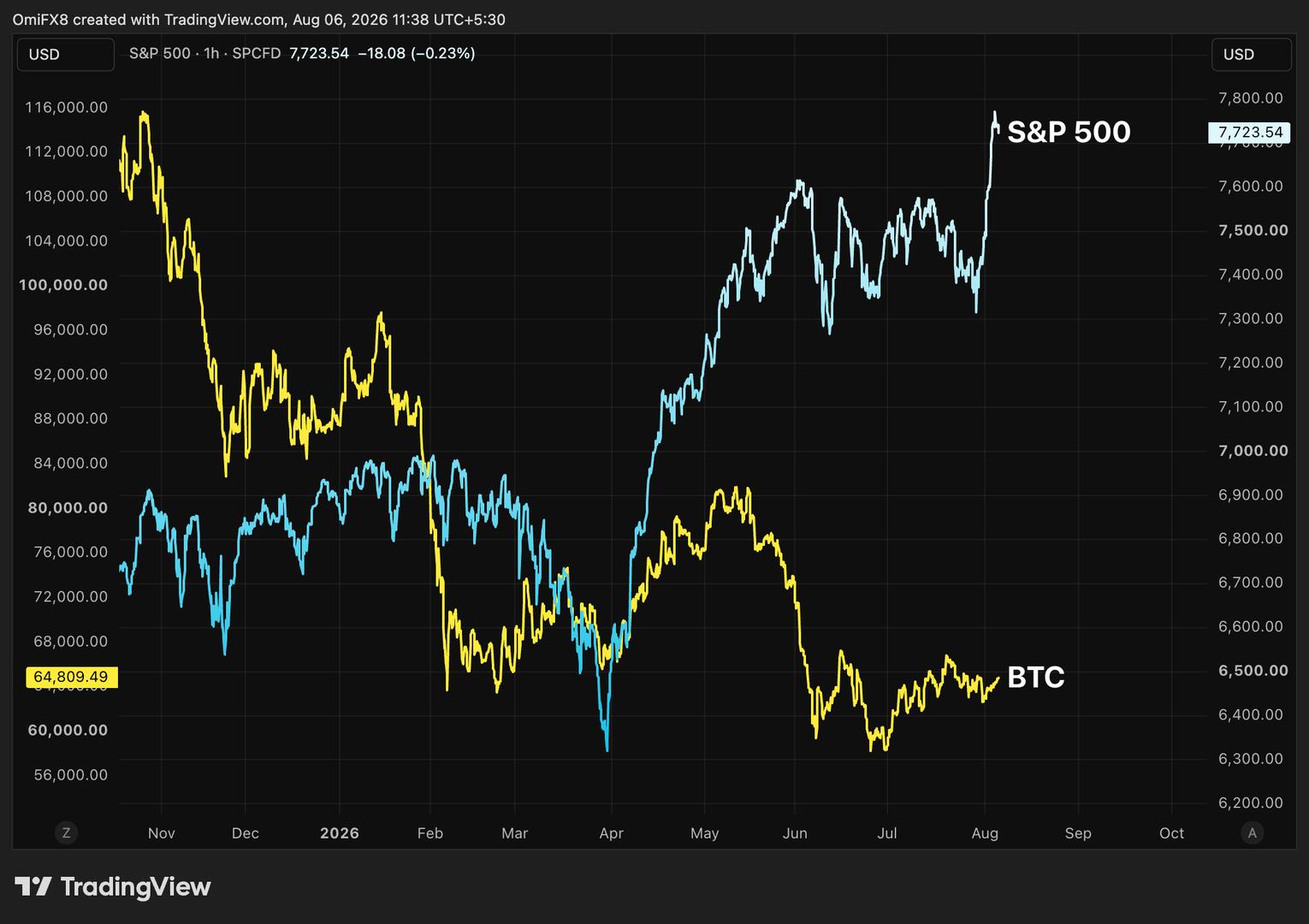
The Trillion-Dollar Divergence: Why Bitcoin Remains Unimpressed by the S&P 500's Historic Surge
The financial markets recently presented a fascinating dichotomy: while the S&P 500 index impressively swelled by approximately $2 trillion this month – a figure roughly equivalent to the entire market capitalization of the cryptocurrency space – Bitcoin, the digital standard-bearer, barely registered a reaction. This stark divergence prompts a critical question for any serious market observer: why has Bitcoin remained largely unimpressed, and what deeper forces are at play beyond the superficial?
The Expected Narratives vs. Market Reality
Initial reactions often gravitate towards a few familiar narratives. Macroeconomic headwinds, such as persistent inflation concerns and the specter of higher-for-longer interest rates from central banks, are frequently cited. The recent Bitcoin halving event also introduces a supply shock dynamic, which historically can lead to a period of consolidation before price appreciation. Furthermore, ongoing regulatory uncertainty, particularly in key markets like the United States, undoubtedly casts a shadow, deterring some institutional inflows.
While these factors are undeniably influential, they do not fully explain the lack of sensitivity to such a monumental capital injection into traditional assets. If anything, a rising tide in broader markets might typically be expected to lift all boats, especially an asset class increasingly touted for its uncorrelated benefits or at least its beta to tech growth. The S&P 500's gains, largely driven by the AI and tech boom, represent a significant reallocation of capital and a strong appetite for growth. Yet, Bitcoin remains largely unmoved, suggesting more nuanced dynamics at play.
Beyond the Obvious: Deeper Currents in Play
1. The Nature of the S&P 500's Gains: Concentrated Alpha
The recent S&P 500 surge hasn't been broad-based. It's largely been concentrated in a handful of mega-cap technology stocks, particularly those riding the Artificial Intelligence wave. This isn't a systemic liquidity flood benefiting all risk assets; rather, it’s a targeted hunt for specific alpha in a high-conviction narrative. Investors pouring into these tech giants are doing so based on established revenue streams, predictable growth models (at least perceived), and tangible product roadmaps. Bitcoin, while a technological marvel, doesn't fit neatly into this immediate, specific growth narrative, especially for traditional funds with strict mandates.
2. Market Maturity and Institutional Discretion
The crypto market is maturing. While once seen as a pure speculative play, it's evolving. This maturity implies that Bitcoin is less likely to swing wildly merely because other markets are moving. Institutional investors, who now hold a more significant sway than in previous cycles, are not operating with the same knee-jerk reaction times as retail traders. Their allocation decisions are strategic, long-term, and often subject to stringent compliance and risk management frameworks. A $2 trillion gain in the S&P 500 doesn't automatically trigger a "buy Bitcoin" signal; rather, it prompts a re-evaluation of portfolio allocations across all asset classes, where crypto must compete on its own merits and risk profile.
3. Internal Crypto Market Dynamics: Sector Rotation and Accumulation
It's crucial to remember that "the crypto market" isn't monolithic. While Bitcoin has been relatively stable, capital could be rotating internally within the broader crypto ecosystem. Perhaps funds are flowing into promising altcoins, DeFi protocols, or specific Web3 projects that are perceived to have higher growth potential or are better aligned with current technological trends. Furthermore, a period of stagnation for Bitcoin can often mask quiet accumulation by long-term holders and institutional players, who prefer to buy during periods of lower volatility and less speculative fervor. The post-halving period is historically one such phase where "smart money" often accumulates before the next bull run.
4. Liquidity and Market Depth: Apples and Oranges
Comparing the S&P 500's $2 trillion gain to Bitcoin's non-reaction is, in some ways, comparing apples and oranges regarding market mechanics. The S&P 500 represents trillions in daily trading volume and immense depth across hundreds of highly liquid assets. A $2 trillion increase, while significant, is absorbed by a market of unparalleled scale. The crypto market, despite its rapid growth, is still comparatively nascent and less liquid. Injecting a similar sum directly into crypto would likely have a much more dramatic impact. The S&P 500's expansion isn't direct capital flowing out of crypto; it's capital circulating within a much larger, deeper traditional financial ecosystem.
5. Regulatory Overhang and Investment Mandates
While often cited, the regulatory environment deserves a deeper look here. For many large traditional institutions, the lack of a clear, unified regulatory framework for crypto remains a significant hurdle. Even with spot Bitcoin ETFs now approved, the broader landscape for digital assets is ambiguous in many jurisdictions. This forces institutions to tread carefully, prioritizing compliance over potentially higher returns in a less regulated space. The S&P 500 offers clear rules of engagement, making it a more comfortable harbor for significant capital, especially during periods of macro uncertainty.
The Road Ahead: What This Divergence Signifies
This episode is less a sign of Bitcoin's irrelevance and more an indication of market segmentation and growing sophistication. It underscores that Bitcoin is no longer solely a reflexive risk-on asset tethered to tech stocks. Its narrative is evolving, with an increasing focus on its role as a digital store of value, a hedge against monetary debasement, and an independent financial rail.
For Bitcoin to "get impressed" and see significant movement, we might need a different set of catalysts. These could include clearer signs of global monetary easing, a decisive shift in the regulatory landscape, or a renewed narrative around digital scarcity and inflation hedging that resonates more broadly than the current AI-driven tech boom. Furthermore, continued institutional adoption and the gradual realization of Bitcoin's utility beyond mere speculation will be crucial.
Ultimately, Bitcoin's stoic silence amidst the S&P 500's exuberance is not a weakness, but perhaps a demonstration of its evolving character. It suggests a market that is consolidating, maturing, and awaiting its own specific triggers, rather than simply riding the coattails of traditional finance's every fluctuation. As senior crypto analysts, we view this as a period of quiet strength, where the groundwork is being laid for future independent growth, rather than a missed opportunity.