Bitcoin's Rally Under Scrutiny: Declining Open Interest and Weak Spot Demand Signal Caution
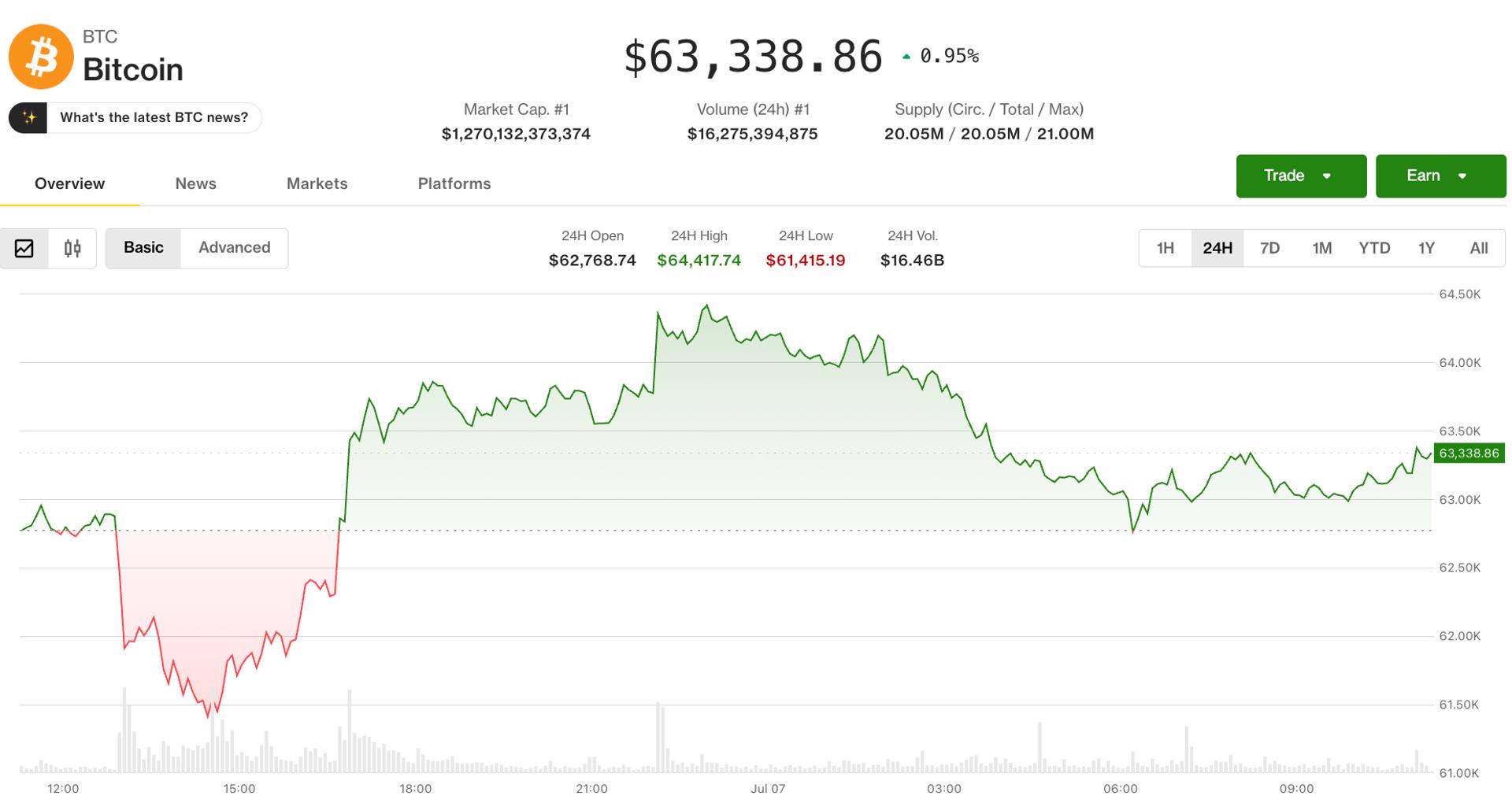
Bitcoin (BTC), the bellwether of the cryptocurrency market, recently retreated from a two-week high of $64,500, casting a shadow of doubt over the sustainability of its modest 8.4% advance throughout July. The pullback isn't merely a routine correction; it's accompanied by two critical technical indicators that warrant close attention from investors and analysts alike: a noticeable decline in open interest (OI) in derivatives markets and persistently weak spot demand. As a senior crypto analyst, my assessment points to a market grappling with uncertainty, where the recent upward momentum appears fragile, lacking the conviction typically required for a sustained breakout.
The immediate trigger for this cautionary stance stems from BTC’s failure to hold key resistance levels, suggesting that bullish momentum is either exhausted or insufficient to overcome selling pressure. While an 8.4% gain in a month might seem respectable, particularly in volatile markets, the underlying mechanics of this rally are now being questioned. Without robust participation and genuine buying conviction across both derivatives and spot markets, any price appreciation risks being short-lived, potentially leading to further consolidation or even a deeper correction.
The Derivatives Dilemma: Unpacking Declining Open Interest
Open interest, or OI, represents the total number of outstanding derivative contracts (futures or options) that have not yet been settled. It's a crucial metric for gauging market participation and liquidity. A rising price accompanied by increasing OI typically signals strong conviction from new capital entering the market, validating the price trend. Conversely, a rising price with declining OI, as we've observed recently, often indicates that the rally is largely driven by short covering or the closing of existing long positions rather than fresh buying interest.
In Bitcoin's current scenario, the dip in open interest suggests that a significant portion of the recent upward movement was not backed by new speculative capital taking fresh long positions. Instead, it implies that traders who were previously short are closing their positions (buying back to cover), or existing long holders are unwinding their positions, taking profits as BTC struggled to maintain its higher price points. This lack of fresh capital infusion into the derivatives market is a red flag. It points to a speculative environment where conviction is waning, and traders are becoming increasingly hesitant to commit to bullish bets at current price levels. The absence of this foundational speculative support can leave the market vulnerable to sharp reversals, as the buying pressure from short covering eventually exhausts itself, revealing underlying weaknesses.
The Critical Role of Spot Demand: A Foundation of Weakness
While derivatives markets provide crucial insights into speculative sentiment, the true health of an asset's price action is fundamentally rooted in spot demand. The spot market involves the immediate exchange of an asset for cash, reflecting genuine buying and selling interest from investors seeking direct ownership. Weak spot demand, therefore, is a far more concerning indicator than a dip in derivatives activity alone, as it suggests a lack of organic buying pressure from long-term holders, institutional investors, and retail participants who wish to acquire actual Bitcoin.
In recent weeks, despite Bitcoin's modest gains, spot trading volumes have largely remained subdued. Data from major exchanges indicates a noticeable absence of substantial buy orders that would typically accompany a conviction-driven rally. This weakness is particularly pronounced among institutional players, whose demand for spot BTC, often facilitated through vehicles like spot Bitcoin ETFs (in regions where they exist) or over-the-counter (OTC) desks, has been less than stellar. The implications are clear: without new capital flowing into the underlying asset, any upward price movement is likely to be unsustainable, prone to pullbacks whenever selling pressure emerges. The absence of strong spot demand fundamentally undermines the narrative of a healthy, accumulating market and instead paints a picture of hesitant participation and a preference for sidelined capital.
Macroeconomic Headwinds and Broader Market Context
Beyond the immediate technicals, the broader macroeconomic landscape continues to exert significant pressure on risk assets, including cryptocurrencies. Lingering concerns over persistent inflation, the trajectory of interest rate hikes by central banks (particularly the U.S. Federal Reserve), and the overall state of global economic growth weigh heavily on investor sentiment. Higher interest rates typically make riskier assets less attractive compared to safer, yield-bearing alternatives. Furthermore, reduced global liquidity, as central banks tighten monetary policy, diminishes the pool of capital available for speculative investments. Bitcoin, despite its narrative as a hedge against inflation, has largely traded as a risk-on asset, making it susceptible to these macroeconomic shifts. A definitive shift in global monetary policy or clearer signs of economic stability could serve as a powerful catalyst, but for now, the macro environment remains largely a headwind.
Technical Outlook and Key Watchpoints
From a technical perspective, Bitcoin's retreat from $64,500 highlights the importance of this level as significant resistance. Immediate support levels are likely to be found around the $60,000 to $61,500 range. A sustained break below these levels, particularly if accompanied by increased selling volume, could signal a deeper retracement towards the lower $50,000s. For a convincing resumption of the uptrend, Bitcoin needs to demonstrate not only a breach of resistance but, crucially, a concurrent increase in both open interest and spot trading volumes, indicating renewed conviction from both speculative and fundamental buyers.
Investors should closely monitor several key data points: daily open interest trends across major exchanges, spot trading volumes, funding rates (which indicate speculative sentiment in perpetual futures), and, perhaps most importantly, institutional inflows into regulated products like spot ETFs. Any significant uptick in these metrics would provide tangible evidence of renewed buying interest and a healthier market structure.
Conclusion: A Cautious Path Forward
The current state of Bitcoin's market suggests a period of consolidation and heightened caution. The July rally, while providing some relief, now appears to be lacking the fundamental support needed for a robust, sustained ascent. The twin signals of declining open interest and weak spot demand serve as critical warnings, indicating that the market is currently driven more by short-term trading dynamics than by deep-seated buying conviction. While Bitcoin's long-term potential remains, the immediate path ahead is likely to be turbulent. A return to sustained upward momentum will necessitate a clear improvement in fundamental buying pressure, evidenced by increasing spot volumes and a healthier derivatives landscape. Until then, investors should approach the market with prudence, prioritizing risk management and awaiting stronger signals of genuine demand.