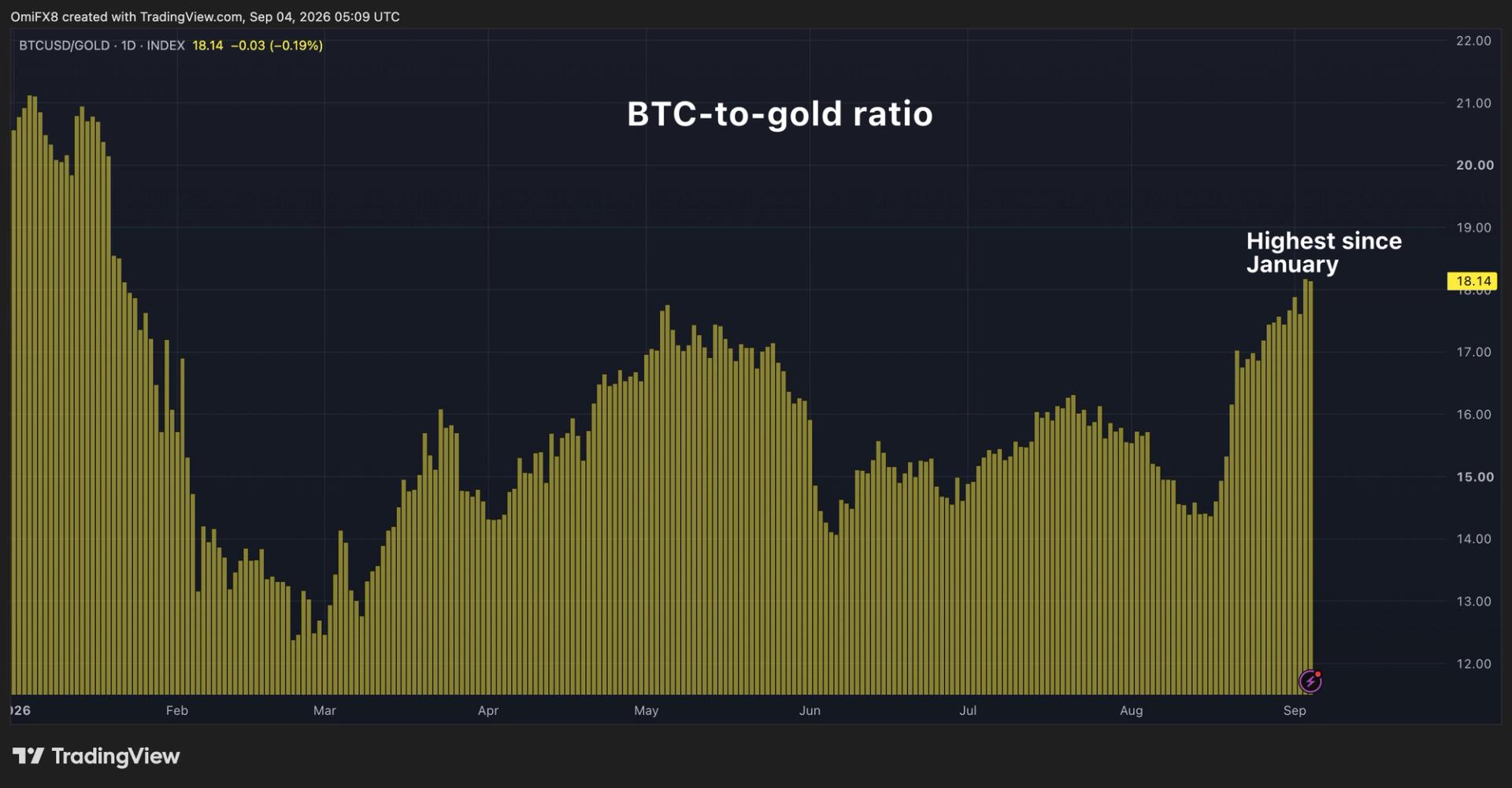
Bitcoin's Golden Conquest: Digital Asset Outpaces Gold as Inflationary Tides Turn
The financial world is abuzz with a striking development: one full Bitcoin now commands a price equivalent to more than 18 ounces of gold, a level not seen since January. This significant outperformance isn't just a fleeting market anomaly; it signals a profound shift in investor sentiment and asset allocation strategies. As a Senior Crypto Analyst, I observe this trend with keen interest, recognizing it as a pivotal moment in the ongoing narrative of hard assets amidst unprecedented global economic uncertainty.
Both Bitcoin and gold, often considered safe havens, have been rallying in tandem. Yet, Bitcoin's ascent has been markedly more aggressive. This simultaneous yet divergent rise is not primarily driven by fluctuating bond yields, as might be expected in traditional risk-off scenarios. Instead, it’s propelled by a deeper, more pervasive fear: the growing apprehension that governments globally will resort to inflating away their colossal debts, rather than undertaking politically difficult fiscal adjustments. This looming specter of fiat currency debasement is fundamentally reshaping how investors perceive and value scarce assets.
The Macroeconomic Headwinds Fueling the Hard Asset Rally
The current global economic landscape is characterized by staggering levels of national debt, exacerbated by expansive fiscal policies enacted during and after the pandemic. Central banks, in an effort to sustain growth and manage debt servicing costs, have maintained ultra-low interest rates and engaged in extensive quantitative easing. While seemingly benign on the surface, this environment breeds a potent cocktail of inflationary pressures. The incentive for governments to allow inflation to erode the real value of their debt is a silent but potent force, undermining the purchasing power of traditional fiat currencies.
In such a climate, the search for assets that can preserve wealth becomes paramount. Investors are increasingly wary of sovereign bonds, whose real returns are often negative, and traditional cash holdings, which are steadily losing value. This macro backdrop creates a fertile ground for "hard money" assets – those with inherent scarcity and resistance to arbitrary supply increases. Historically, gold has been the undisputed champion in this category. However, the digital age has introduced a formidable new contender in Bitcoin, which is now demonstrating its mettle in spectacular fashion.
Bitcoin's Ascendance: More Than Just 'Digital Gold'
Bitcoin's fundamental properties position it uniquely in this environment. Its absolute scarcity, capped at 21 million units, stands in stark contrast to gold, whose supply, while finite, is subject to continuous, albeit diminishing, new extraction. This programmatic scarcity, enforced by its decentralized network, offers an unprecedented level of supply predictability and resistance to manipulation. Beyond scarcity, Bitcoin boasts unparalleled divisibility, ease of transfer across borders, and censorship resistance – attributes that are increasingly valued in a hyper-connected, digital-first world.
What began as a niche technological experiment has matured into a globally recognized asset class, attracting significant institutional interest. The launch of spot Bitcoin ETFs in major markets, corporate treasury allocations, and even adoption by nation-states like El Salvador underscore its growing legitimacy. Bitcoin is no longer merely "digital gold"; it is evolving into a foundational layer for a new financial paradigm, offering not just a hedge against inflation but also a robust, permissionless alternative to traditional financial rails. Its superior performance isn't solely a function of its higher volatility; it reflects a rapidly expanding network effect and a deepening conviction in its long-term value proposition as a superior form of hard money.
Gold's Enduring Appeal, Yet Current Underperformance Against Bitcoin
Gold, with its millennia-long history as a store of value, safe haven, and hedge against economic turmoil, undoubtedly retains its allure. Its tangible nature, universal acceptance, and lack of counterparty risk provide a sense of security unmatched by most assets. For many investors, especially those with a traditional mindset, gold remains an indispensable component of a diversified portfolio, offering stability and a proven track record during crises. It's rallying now, reflecting the same inflationary fears driving Bitcoin.
However, gold also comes with practical limitations that become more pronounced in our digital era. Physical storage, insurance, and the logistical challenges of transport and verification can be cumbersome and costly. Its relative illiquidity compared to a digitally transferable asset like Bitcoin can also be a drawback in certain scenarios. While gold's market depth is immense, its scale also means that price movements tend to be more gradual and less explosive than those observed in the relatively younger, though rapidly maturing, Bitcoin market. In the current environment, where rapid value preservation and seamless transferability are increasingly prioritized, gold's physical characteristics, ironically, hinder its agility.
The Divergence: Why Bitcoin is Pulling Ahead Now
The current divergence, where Bitcoin significantly outpaces gold, can be attributed to several factors converging simultaneously. Firstly, there's a powerful narrative shift underway. Bitcoin is increasingly being recognized not just as a hedge against inflation but as a potential hedge against broader systemic risks associated with unchecked monetary expansion and political instability. Its decentralized nature offers a compelling alternative to centralized financial systems perceived as vulnerable.
Secondly, market dynamics play a crucial role. Bitcoin's lower market capitalization compared to gold means that new capital inflows have a more magnified impact on its price. As institutional adoption accelerates, these inflows are becoming substantial, driving its valuation higher at a faster rate. The ease of access through regulated vehicles further lowers the barrier to entry for mainstream investors. Thirdly, a demographic shift is at play; younger, digitally native investors are often more inclined to embrace Bitcoin, viewing it as a modern, technologically superior form of money and a reflection of their economic anxieties and aspirations.
Implications and the Road Ahead
This "golden conquest" by Bitcoin is more than just a momentary triumph; it signals a fundamental re-evaluation of what constitutes a premier hard asset in the 21st century. While gold will undoubtedly maintain its historical significance and a place in diversified portfolios, Bitcoin's superior technological attributes, absolute scarcity, and increasing mainstream acceptance are positioning it as a potent challenger, especially among forward-looking investors concerned about long-term wealth preservation.
The road ahead for Bitcoin, while promising, will still involve periods of volatility, regulatory scrutiny, and ongoing debates about its energy consumption. However, its increasing correlation with traditional safe-haven assets like gold during times of macroeconomic stress further solidifies its emerging role. The question is no longer if Bitcoin is a legitimate hard asset, but rather how large a share of the "hard money" market it will ultimately command. The current trend suggests it’s far from reaching its full potential, continuing to carve out a dominant position in the evolving financial landscape where digital scarcity reigns supreme.