Bitcoin Flashes Warning Signs as $58,000 Support Tested Amidst Derivatives Carnage
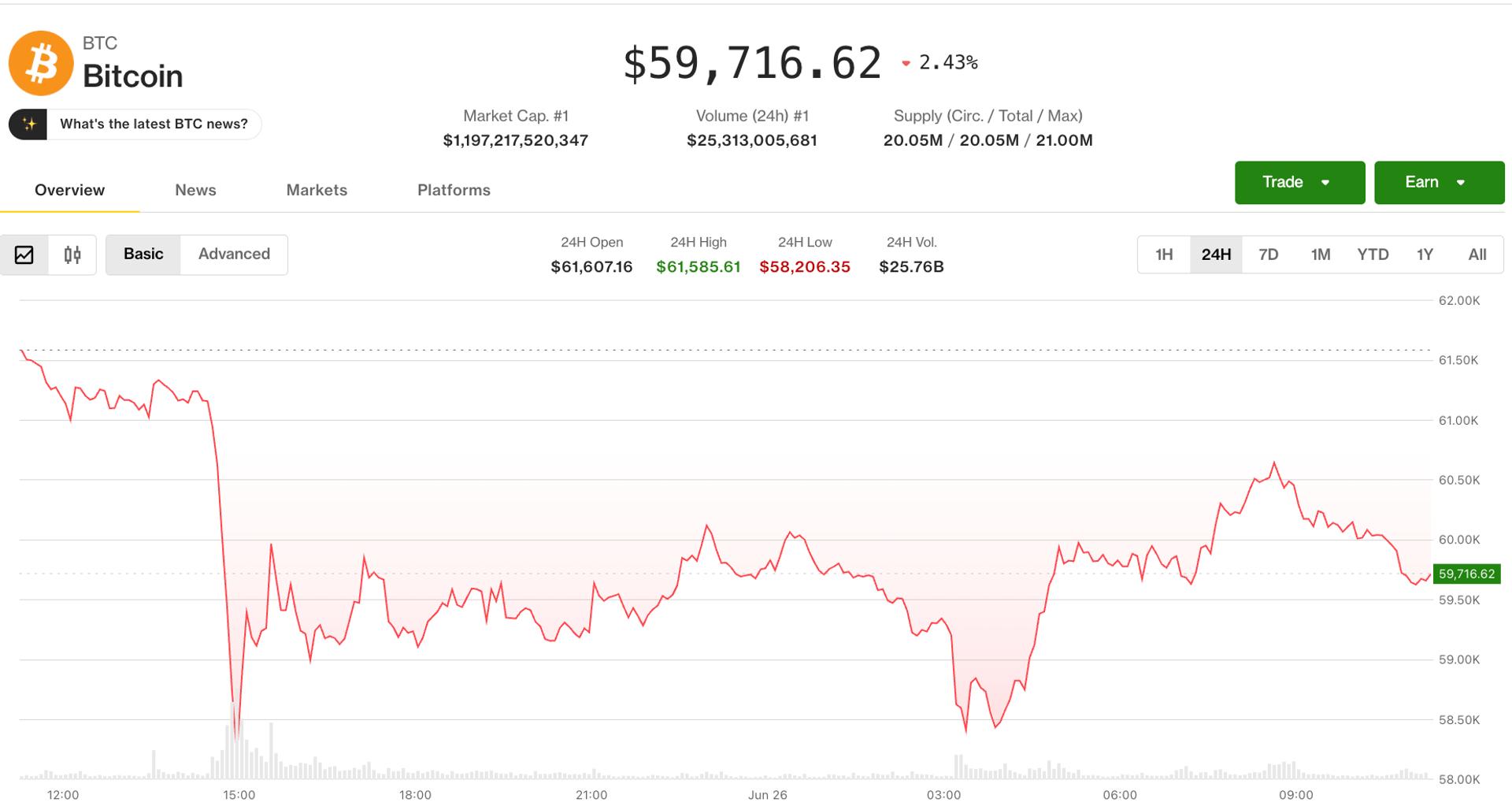
The cryptocurrency market recently endured a turbulent period, with Bitcoin (BTC) dipping dramatically to a critical low of $58,000 before staging a modest rebound. This precipitous drop, a level not witnessed since the early months of 2024 and marking a significant retest of crucial support, sent ripples of concern throughout the digital asset ecosystem. While BTC managed to claw its way back to around $59,770, the recovery feels precarious, overshadowed by a staggering $1 billion in futures liquidations and a noticeable continued slide in Ethereum (ETH) prices. As a Senior Crypto Analyst, my assessment points to a market gripped by uncertainty, where derivative market dynamics are amplifying existing pressures and signaling potential for further downside.
The Plunge and the Precarious Rebound: A Battle for Support
Bitcoin's journey below the psychological $60,000 mark and its brief touch of $58,000 represent more than just a price movement; it signifies a serious challenge to a key support zone established earlier in the year. This level, crucial for maintaining the bullish narrative, saw intense selling pressure, likely exacerbated by a confluence of factors including macro-economic headwinds, profit-taking from earlier gains, and a cooling off period post-halving. The subsequent bounce to $59,770, while offering a temporary reprieve, appears largely technical – a short squeeze as overly aggressive short positions were forced to cover, or a swift dip-buying opportunity that may not signify a fundamental shift in sentiment. The immediate resistance lies firmly at the $60,000 to $62,000 range, and a sustained break above this level, backed by strong spot volume, is essential to alleviate immediate bearish fears.
Derivatives Unleashed: The $1 Billion Liquidation Avalanche
The most alarming signal emerging from this market downturn is the sheer scale of liquidations in the derivatives market. A $1 billion wipeout of futures positions is not just a statistic; it's a testament to the excessive leverage permeating the market. When prices move sharply against leveraged positions, exchanges automatically close these positions, leading to a cascading effect that intensifies price movements. In this instance, the majority of liquidations were likely long positions, caught off guard by Bitcoin's sudden descent. This event highlights a persistent vulnerability: too many traders are using high leverage, making the market susceptible to violent swings. Analysts are closely watching funding rates and open interest. While a significant liquidation event can sometimes 'cleanse' the market of excess leverage, the underlying sentiment suggested by derivatives metrics indicates a cautious and potentially bearish outlook, with funding rates occasionally dipping negative and perpetual open interest remaining elevated relative to market cap, suggesting a lingering risk of further volatility driven by speculative positioning.
Ethereum's Lag: A Broader Market Indicator
Adding another layer of concern is Ethereum's continued underperformance, slipping further even as Bitcoin attempted to stabilize. ETH's weakness can be attributed to several factors. The initial euphoria surrounding the spot Ethereum ETF applications has somewhat subsided, replaced by a more realistic assessment of the timeline and potential impact. Furthermore, in periods of market uncertainty, investors often rotate out of riskier assets, including altcoins, and consolidate into Bitcoin or stablecoins. ETH's inability to hold its ground signals a broader 'risk-off' sentiment prevalent in the market, which typically foreshadows tougher times for the wider altcoin ecosystem. When the second-largest cryptocurrency struggles, it reflects a lack of conviction across the board and can exacerbate outflows from smaller cap tokens.
Navigating the Road Ahead: An Analyst's Perspective
Looking forward, the immediate future for Bitcoin and the broader crypto market appears fraught with uncertainty. From a technical standpoint, the $58,000 level has now been re-validated as a critical support. A sustained breach below this point could open the door for a retest of $55,000, and potentially even $52,000, which would represent a significant correction from recent highs. Conversely, reclaiming and holding above $62,000 would instill much-needed confidence.
Fundamentally, several factors will dictate the market's trajectory. Macroeconomic data, particularly inflation reports and central bank interest rate decisions, will continue to play a pivotal role. Any hawkish signals from the Federal Reserve could dampen risk appetite. On-chain metrics, such as the activity of long-term holders and miner capitulation dynamics, will also offer insights. Crucially, the derivatives market will remain a bellwether. Persistent negative funding rates or a renewed surge in open interest with a bearish bias could signal further pain in the pipeline, indicating that traders are positioning for continued declines or are highly leveraged on the short side, which can lead to volatility. While institutional adoption and the long-term scarcity narrative for Bitcoin remain strong, market participants must acknowledge the immediate risks posed by high leverage and macro-economic pressures.
Conclusion: Vigilance in a Volatile Market
Bitcoin's recent volatility, the critical test of $58,000 support, and the massive derivatives liquidations underscore the need for extreme caution. While the crypto market has shown resilience in the past, the current signals suggest that the path forward will likely be characterized by continued turbulence. Investors should prioritize risk management, consider reducing excessive leverage, and focus on long-term conviction rather than short-term speculative plays. The 'pain in the pipeline' signaled by derivatives is a stark reminder that market corrections, even sharp ones, are an inherent part of the crypto cycle. Vigilance and a well-defined strategy will be paramount for navigating these choppy waters.