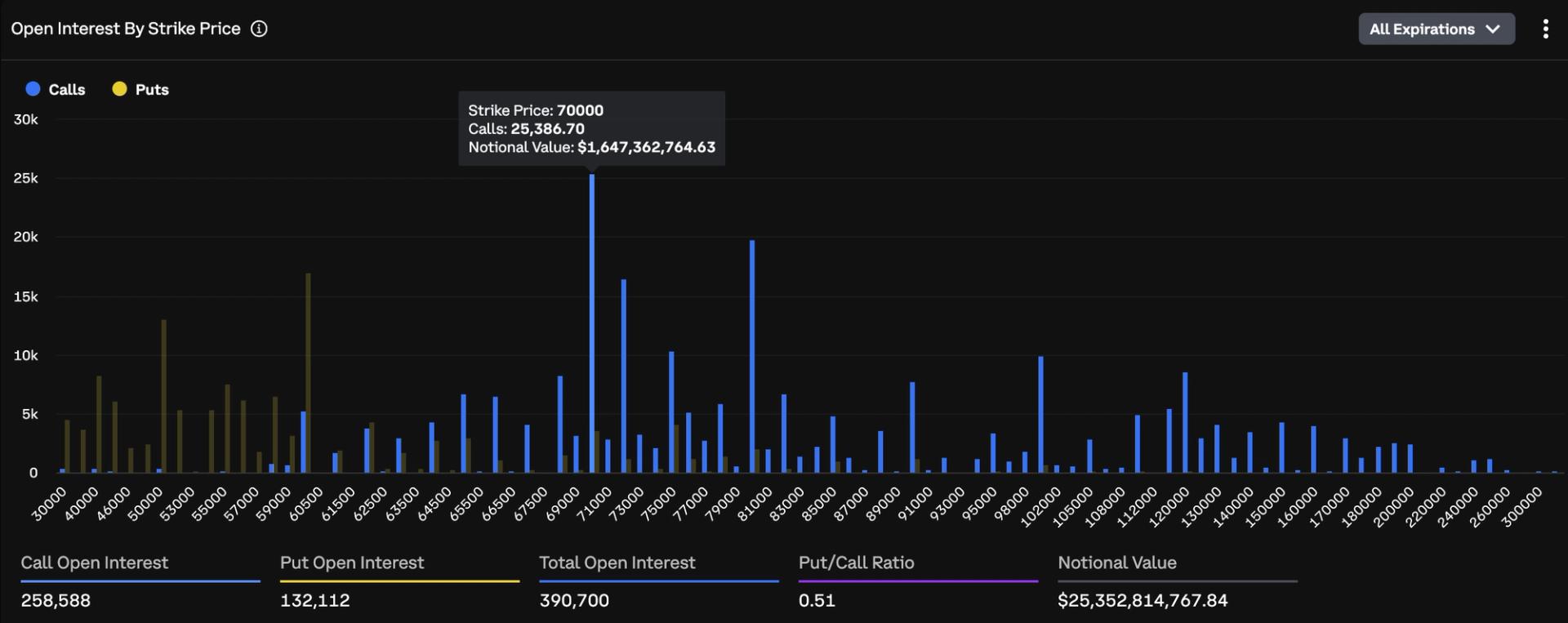
Bitcoin's $150,000 Ambition Recalibrated: Popular Call Option Strike Shifts Downward by $10,000
As the crypto world wakes to July 18, 2026, a significant tremor is rippling through the derivatives market: the most widely tracked Bitcoin (BTC) call option has seen its popular strike price effectively slip by a notable $10,000. This isn't merely a minor fluctuation; it signals a material recalibration of market expectations for Bitcoin's near-term upside trajectory, and demands a thorough analysis from all serious participants.
For months, a particular Bitcoin call option—speculated to be the December 2026 expiry with a strike price around the psychological $150,000 mark—has dominated open interest and trading volumes. This strike represented a powerful consensus among bulls, a future price target underpinned by a combination of accelerating institutional adoption, robust network fundamentals post-halving cycles, and the persistent narrative of Bitcoin as a digital store of value amidst ongoing global economic uncertainties. Its popularity underscored a fervent belief that Bitcoin was marching steadily towards new all-time highs, with $150,000 serving as a pivotal milestone.
Understanding the $10,000 Slip
The 'slip' refers not necessarily to a sudden $10,000 drop in premium for an existing option, but rather a discernible shift in market conviction. What was once the focal point of bullish speculation – the $150,000 strike – has seen its implied probability wane significantly. Derivatives traders, by adjusting their positions and focusing new open interest on a lower strike (e.g., $140,000 for the same December 2026 expiry), are effectively signaling a reduction in the collective belief that BTC will comfortably reach or surpass the original $150,000 target within the timeframe. This movement suggests a broader market adjustment, where the collective 'dream price' has been nudged downwards, reflecting a more cautious, or perhaps realistic, outlook.
Implications for Market Sentiment and Strategy
The immediate implication is a noticeable cooling of bullish fervor. While not necessarily a signal of outright bearishness, it indicates a decrease in aggressive upside positioning. This could lead to reduced leverage, as traders who had heavily bet on the $150,000 mark might begin to unwind some of their leveraged positions, leading to potential spot market pressure. Another consequence is increased profit-taking; holders of deeply in-the-money call options or those with significant spot gains might view this as a cue to realize gains, further contributing to selling pressure. We could also anticipate a volatility shift, where implied volatility might see a re-rating, particularly for higher strike options, as the probability distribution of future prices shifts. Finally, institutional desks will likely undergo a strategy re-evaluation, reviewing their delta-hedging strategies and overall portfolio allocation, potentially reducing exposure to highly speculative long positions.
Potential Drivers Behind the Recalibration
A $10,000 shift in a popular strike price doesn't happen in a vacuum. Several factors, both macroeconomic and crypto-specific, could be contributing to this recalibration:
Macroeconomic Headwinds
Despite the optimism surrounding Bitcoin, the broader global economic landscape remains a significant influencer. Recent indications of persistent inflation in key economies, coupled with hawkish rhetoric from central banks hinting at the possibility of further rate hikes or prolonged tightening cycles, might be dampening risk appetite. Geopolitical tensions, which have simmered throughout 2025 and into 2026, could also be prompting a flight to perceived safety assets over riskier, volatile plays like crypto.
Regulatory Uncertainty
While the regulatory environment has matured significantly, specific jurisdictions continue to grapple with comprehensive crypto frameworks. Lingering uncertainty around stablecoin legislation, the classification of certain tokens, or new compliance burdens for institutional players could be fostering a cautious approach, especially for long-dated, high-conviction bets.
Post-Halving Dynamics and ETF Inflows
The market might still be digesting the full impact of the 2024 halving. While historically a bullish catalyst, the 'sell the news' phenomenon or a slower-than-anticipated supply shock absorption could be leading to a period of consolidation. Furthermore, after a parabolic surge in Bitcoin ETF inflows through late 2024 and 2025, there might be signs of moderation or even some net outflows, suggesting that a significant tranche of institutional capital has already entered, and new capital is flowing in at a slower pace.
Technical Resistance and On-Chain Data
From a technical perspective, Bitcoin's price may have encountered robust resistance levels around previous peaks or psychological thresholds, failing to sustain breakthroughs. This could lead options traders to believe a consolidation or minor pullback is more likely before a renewed assault on higher levels. On-chain data might also be signaling a period of reduced accumulation from whales or long-term holders, or an increase in supply moving to exchanges, suggesting profit-taking is in play.
Looking Ahead: What to Watch
The next few weeks will be crucial for discerning whether this shift is a temporary adjustment or indicative of a more prolonged period of sideways action or even a deeper correction. Key indicators to monitor include open interest and volume, specifically tracking where new open interest is congregating across different strike prices and expiries – a shift towards lower strikes or even put options would be telling. Funding rates also bear watching, as a significant dip on perpetual futures could signal a reduction in leveraged long interest. Consistent net outflows from Bitcoin ETFs would serve as a strong indication of waning institutional demand, while upcoming macroeconomic releases such as inflation reports, central bank minutes, and jobs data will be critical for assessing global risk appetite. Lastly, on-chain metrics deserve close attention; insights into whale accumulation, exchange net flows, and miner behavior can provide crucial clues about market structure.
Conclusion
The $10,000 downward slip in the most popular Bitcoin call option's effective strike price is a significant signal from the sophisticated corners of the derivatives market. It represents a recalibration of collective optimism, urging a more nuanced and cautious approach. While Bitcoin’s long-term potential remains robust, the short-to-medium term could be characterized by increased consolidation, price discovery at lower levels, and a careful re-evaluation of aggressive bullish targets. As always, the derivatives market acts as a potent barometer for future expectations, and this latest reading suggests prudence over exuberance.