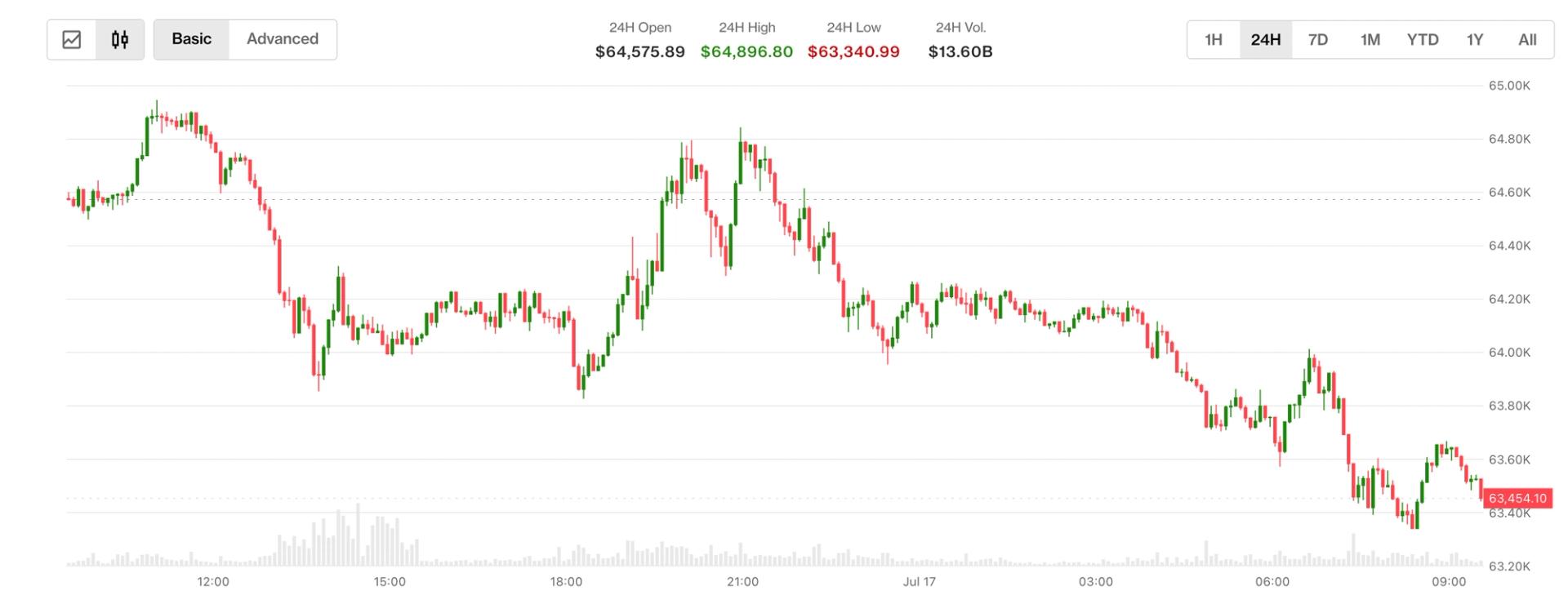
Bitcoin's Retreat: A Confluence of Geopolitical Storms
Bitcoin, the bellwether of the cryptocurrency market, found itself navigating choppy waters this week, dipping below the critical $63,000 mark. The downturn isn't merely a technical correction; it's a stark reminder of the asset's increasing sensitivity to global macroeconomic and geopolitical shifts. Two primary drivers have cast a shadow over risk assets, including Bitcoin: a renewed U.S. military strike in the Middle East, specifically targeting Iran, and the re-emergence of U.S.-China trade friction rhetoric following comments from former President Donald Trump.
As a senior crypto analyst, it's crucial to dissect these interconnected events to understand their profound implications for Bitcoin's evolving narrative – oscillating between a digital safe haven and a high-beta risk asset. The current environment tests the very foundation of Bitcoin's 'digital gold' thesis, forcing investors to grapple with its true nature in times of global instability.
The Middle East Crucible: Immediate Risk Aversion
The news of a U.S. strike on Iran immediately sent ripples across global financial markets. Geopolitical escalations in the Middle East historically trigger a 'risk-off' sentiment, prompting investors to shed volatile assets in favor of perceived safe havens like the U.S. dollar, Treasury bonds, and physical gold. While Bitcoin has often been championed as 'digital gold' – an uncorrelated asset class offering refuge from traditional market turmoil and fiat debasement – its performance during such immediate, sharp geopolitical shocks frequently tells a different story.
In the short term, Bitcoin's correlation with traditional risk assets, particularly tech stocks, tends to heighten. The immediate flight to liquidity and safety often sees capital flow out of highly speculative or volatile assets, regardless of their long-term value proposition. The recent dip suggests that a significant portion of Bitcoin's investor base still views it through the lens of a growth asset, prone to sell-offs when global stability is threatened. This is a critical distinction that seasoned investors must acknowledge: while Bitcoin may act as a hedge against systemic fiat currency issues or long-term inflation, its capacity as an immediate safe harbor during kinetic geopolitical events remains debatable and often overridden by broader market sentiment.
Trump's China Comments: Rekindling Economic Uncertainty
Adding another layer of complexity to the market's anxieties are former President Trump's comments regarding China. While specific details remain fluid, any hint of renewed U.S.-China trade wars or increased economic protectionism sends shivers down the spine of global markets. The last era of significant U.S.-China trade friction led to considerable supply chain disruptions, reduced global growth forecasts, and widespread uncertainty, impacting everything from manufacturing to technology sectors.
For Bitcoin, the implications are multifaceted. A potential trade war could stifle global economic growth, reducing overall liquidity and investor appetite for risk. Furthermore, such an environment could trigger a broader sell-off across equities, dragging Bitcoin down with it due to its increasing institutional adoption and integration into traditional portfolios. The narrative of Bitcoin being completely 'decoupled' from traditional financial markets faces significant scrutiny under these conditions. While some argue that Bitcoin could benefit from a flight away from fiat currencies embroiled in trade disputes, the immediate reaction typically leans towards a contraction in global risk appetite, impacting even the most innovative asset classes.
Bitcoin's Evolving Identity: Safe Haven or Risk Asset?
The dual pressures from Middle Eastern tensions and renewed U.S.-China frictions highlight the ongoing identity crisis for Bitcoin. Is it a true uncorrelated safe haven, a 'digital gold' for the 21st century, or is it still largely a high-beta growth asset susceptible to the same global shocks that affect equity markets?
The current data suggests a nuanced reality. While Bitcoin possesses characteristics that could make it a long-term hedge (decentralization, scarcity, censorship resistance), its price action in the face of immediate, widespread risk-off events indicates a significant correlation with broader market sentiment. This is partly due to its increasing institutionalization; as more traditional funds and corporations allocate to Bitcoin, its price becomes more sensitive to the macroeconomic factors that dictate traditional portfolio management decisions.
Liquidity also plays a role. In times of panic, investors often seek the most liquid assets for quick exits. While Bitcoin's liquidity has grown exponentially, it still pales in comparison to traditional safe havens like sovereign bonds or the U.S. dollar, which can absorb massive capital flows with minimal price impact.
The Road Ahead: Navigating Uncertainty
For investors, the immediate future hinges on the de-escalation of these geopolitical flashpoints. Any signs of diplomatic resolution in the Middle East or clarity regarding U.S.-China economic policy could provide relief to risk assets. Conversely, an escalation on either front could prolong Bitcoin's current consolidation or lead to further price corrections.
Long-term Bitcoin maximalists will likely view these dips as buying opportunities, emphasizing the asset's fundamental strengths in a world grappling with inflation, geopolitical instability, and a potential erosion of trust in traditional financial systems. However, short-term traders and those with a lower risk tolerance must remain vigilant, recognizing Bitcoin's current susceptibility to global risk-off events.
In conclusion, Bitcoin's recent price action serves as a potent reminder that even the most revolutionary assets are not immune to the gravitational pull of global events. As a senior crypto analyst, my view is that while Bitcoin's long-term value proposition remains robust, its journey to becoming a universally accepted safe haven is still very much in progress, navigating a complex landscape where geopolitical headwinds can, and do, exert significant influence.