Bitcoin Breaches $76,000: A New Era of Institutional Dominance
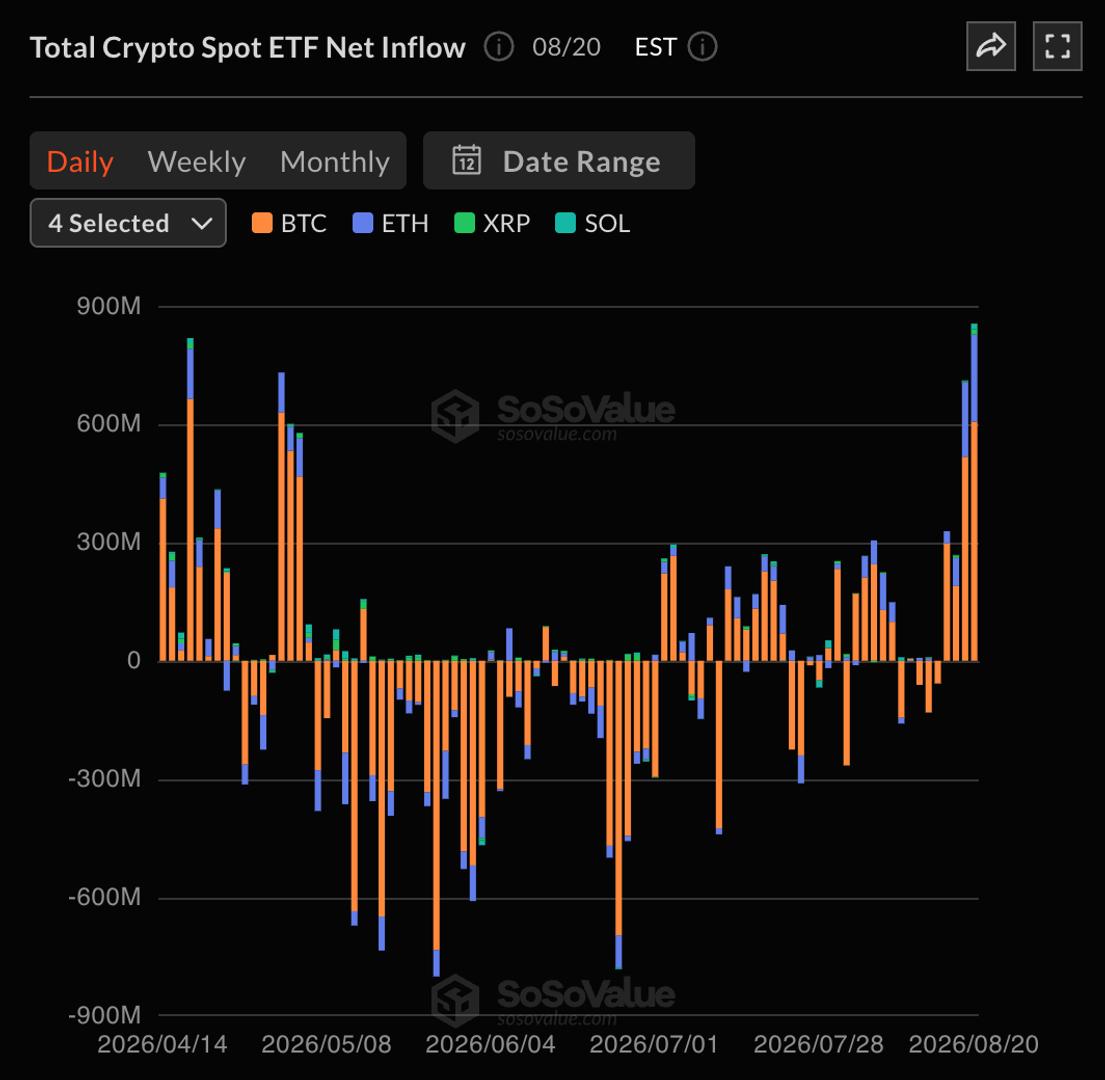
The cryptocurrency market has once again captured global attention, with Bitcoin (BTC) dramatically surging past the $76,000 mark. This impressive price action on August 20th wasn't just a testament to renewed investor confidence but was fundamentally underpinned by a monumental influx of capital into spot Bitcoin and Ether exchange-traded funds (ETFs). On this single day, these institutional vehicles collectively pulled in an astounding $800 million, signaling an undeniable and accelerating institutional bid behind the current bull run. As a Senior Crypto Analyst, the implications of this convergence of price discovery and institutional validation are profound, reshaping the narrative and structure of the digital asset landscape.
The Unprecedented Institutional Influx: Bitcoin ETFs Lead the Charge
The raw numbers from August 20th paint a vivid picture of institutional appetite. Spot Bitcoin ETFs alone attracted a staggering $606 million. This figure isn't just large in isolation; it represents a significant increase from the prior day's inflows, demonstrating sustained and growing conviction among sophisticated investors. The approval of spot Bitcoin ETFs earlier this year was hailed as a watershed moment, promising to bridge traditional finance with the crypto world. We are now witnessing the full realization of that promise, with these products acting as powerful conduits for institutional capital that previously faced significant hurdles to direct crypto exposure.
This institutional embrace is fundamentally altering Bitcoin’s market dynamics. Unlike previous bull cycles often characterized by retail-driven euphoria and speculative fervor, the current surge appears to be driven by entities with deeper pockets and longer-term investment horizons. Large-scale capital deployment through ETFs effectively reduces the available supply of BTC on exchanges, creating a supply shock scenario that exerts upward pressure on prices. When hundreds of millions of dollars flow into these funds daily, it translates into enormous buying pressure that simply cannot be absorbed without significant price appreciation.
Ethereum's Resurgence: Ether ETFs Signal Broader Market Acceptance
While Bitcoin rightfully garners the headlines for its price milestone, the performance of Ether funds on August 20th is equally compelling and perhaps even more telling for the broader crypto ecosystem. Ether ETFs attracted $221 million, also surpassing their prior day's performance. This robust inflow into Ethereum-focused products signifies that institutional interest is not confined solely to Bitcoin as a digital store of value but extends to Ethereum as the leading smart contract platform and the backbone of decentralized finance (DeFi) and NFTs.
The institutional adoption of Ether ETFs validates Ethereum's critical role and technological superiority. It demonstrates a growing understanding among institutional players of Ethereum's utility, its deflationary tokenomics post-Merge, and its potential as a global settlement layer. This diversification of institutional capital beyond just Bitcoin suggests a maturing market where investors are increasingly comfortable allocating to different segments of the crypto economy, fostering broader market stability and growth.
Analyzing the Market Structure: Supply, Demand, and the ETF Effect
The combined $800 million inflow within a single day into BTC and ETH ETFs is not merely a quantitative achievement; it's a qualitative shift in market structure. Every dollar flowing into these ETFs is, in essence, a demand for the underlying asset, which fund providers must purchase from the open market. This sustained buying pressure, day after day, week after week, creates a powerful feedback loop. As prices rise, more institutions may feel compelled to enter, fearing they will miss out on the rally, thereby fueling further inflows.
Moreover, the 'stickiness' of ETF investments tends to be higher than individual retail holdings. Institutions typically have less reactive trading strategies, often holding assets for longer periods as part of diversified portfolios. This means that the Bitcoin and Ether acquired by ETFs are effectively taken out of immediate circulation, reducing selling pressure and contributing to a more stable accumulation phase. The implication is a potential paradigm shift from highly speculative, volatile retail-dominated markets to more institutionally anchored, demand-driven environments.
Looking Ahead: Opportunities, Risks, and the Road to Price Discovery
With Bitcoin now firmly above $76,000 and strong institutional backing, the market enters a phase of significant price discovery. While there are no guarantees, the fundamental supply-demand dynamics created by sustained ETF inflows suggest that further upside potential exists. Key resistance levels become psychological barriers rather than fundamental ceilings. We might see an accelerated push towards new all-time highs as FOMO (Fear Of Missing Out) permeates both retail and institutional corridors.
However, as with any rapidly appreciating asset, risks remain. Profit-taking could lead to short-term corrections, and macro-economic factors, such as shifts in global monetary policy or unexpected geopolitical events, could introduce volatility. Regulatory uncertainties, although seemingly easing with ETF approvals, always lurk in the background. As an analyst, I advise vigilance and a balanced perspective. While the institutional bid provides a strong foundation, the crypto market remains inherently dynamic.
In conclusion, August 20th stands out as a pivotal day, solidifying the narrative of institutional adoption as the primary driver of this bull market. Bitcoin's ascent past $76,000, hand-in-hand with robust ETF inflows for both BTC and ETH, marks a significant maturation of the cryptocurrency space. We are witnessing a fundamental rerating of digital assets by the traditional financial world, positioning them as legitimate, investable assets that are here to stay and continue shaping the future of global finance.