The Great Rotation: From Silicon to Digital Gold
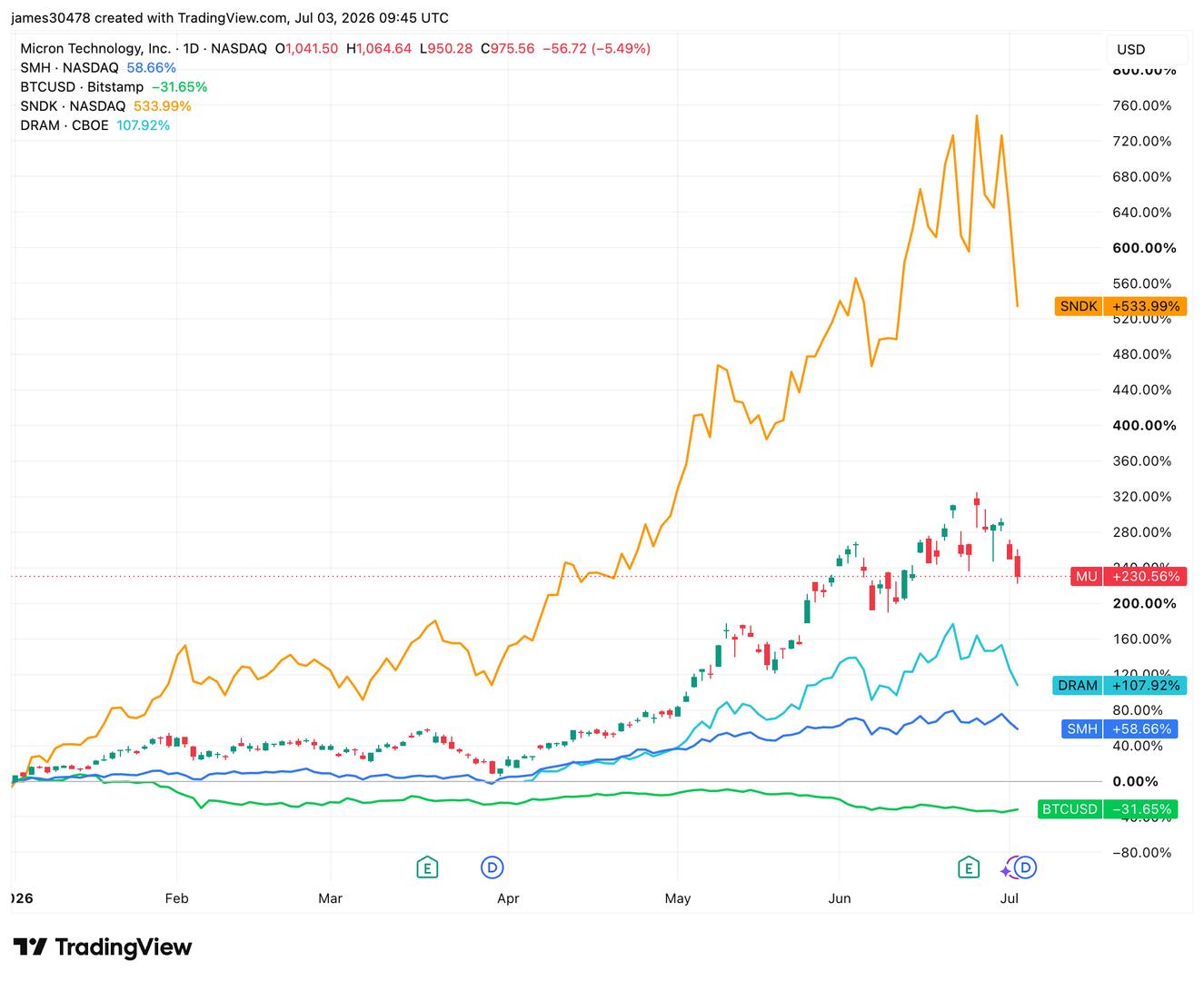
After a period of unprecedented ascendancy, the titans of innovation – AI-tied memory and semiconductor stocks – appear to be losing their formidable grip on market momentum. Throughout 2026, these high-growth sectors were the darlings of investors, fueled by an insatiable demand for processing power and intelligent systems. Their relentless surge not only defined portfolio returns but also overshadowed alternative asset classes. However, recent market movements suggest a distinct shift in sentiment, prompting a crucial question for allocators worldwide: is this the moment capital pivots back into Bitcoin?
As a senior crypto analyst, observing the ebb and flow of market cycles is paramount. The narrative surrounding AI and semiconductors reached a fever pitch, with valuations often stretching beyond conventional metrics, priced for perfection amidst exponential growth projections. While the underlying technological advancements remain undeniable, market saturation, increased competition, regulatory scrutiny, and perhaps, simply the exhaustion of a multi-year bull run within these specific sectors, are now contributing to a noticeable deceleration. Investors, ever searching for alpha, are beginning to recalibrate their exposure, seeking new frontiers for growth or, conversely, safer harbors from potential overvaluation.
The Waning Allure of High-Flying Tech
The dominance of AI and semiconductor stocks in 2026 was a testament to the transformative power of artificial intelligence. Companies at the forefront of chip manufacturing, memory solutions, and AI infrastructure enjoyed unparalleled investor confidence, leading to stratospheric gains. Yet, even the most robust narratives eventually encounter headwinds. We are now witnessing early signs of profit-taking, as smart money looks to de-risk after significant run-ups. The law of large numbers also begins to apply; maintaining hyper-growth rates becomes increasingly challenging as market capitalization expands into the trillions. Furthermore, geopolitical tensions, supply chain reconfigurations, and the inherent cyclicality of the semiconductor industry, even when augmented by AI demand, can contribute to periods of consolidation or correction.
This cooling-off period is not necessarily an indictment of the long-term prospects of AI, but rather a reflection of market dynamics seeking equilibrium. Capital, like water, always seeks the path of least resistance and greatest opportunity. When one well-trodden path becomes crowded and expensive, alternative avenues inevitably gain appeal. The question, then, is which alternative is best positioned to absorb this shifting liquidity, and why Bitcoin emerges as a compelling candidate.
Bitcoin's Resurgence: A Signal of Changing Focus
Against this backdrop of softening tech performance, Bitcoin has shown remarkable resilience, registering a notable rebound. This divergence is not accidental; it speaks to a fundamental re-evaluation of asset allocation strategies. Bitcoin, often dubbed 'digital gold,' has matured significantly since its inception, moving beyond mere speculative fervor to be recognized as a legitimate store of value, an inflation hedge, and a potential safe-haven asset in an increasingly complex financial landscape.
The core value proposition of Bitcoin lies in its decentralized nature, finite supply, and resistance to censorship. In an environment where traditional equity markets, particularly those with concentrated sector bets, show signs of fatigue, Bitcoin offers an uncorrelated return potential. Its intrinsic scarcity, codified by its programmed halving events (the most recent of which might have occurred pre-2026, setting the stage for subsequent supply shocks), continues to underpin its long-term appreciation thesis. Institutions, having progressively integrated Bitcoin into their portfolios since the early 2020s, now view it less as a fringe asset and more as a strategic diversifier.
Catalysts for a Crypto Capital Influx
Several factors could accelerate the reallocation of capital from AI stocks to Bitcoin. Firstly, market rotation is a natural phenomenon. After a sector's incredible run, investors seek new narratives or return to established, yet undervalued, assets. Bitcoin, with its unique macro profile, often presents such an opportunity.
Secondly, the search for portfolio diversification plays a critical role. Overweighting a single sector, no matter how promising, exposes portfolios to idiosyncratic risks. Bitcoin, with its distinct economic drivers and lack of direct correlation with the tech equity market, offers genuine diversification benefits. Thirdly, should broader macroeconomic conditions, such as persistent inflationary pressures or renewed concerns about global financial stability, persist into 2026 and beyond, Bitcoin's role as a hard asset and a hedge against fiat debasement becomes increasingly attractive.
Moreover, the ongoing maturation of the crypto ecosystem – including improved regulatory frameworks, the proliferation of institutional investment products like spot Bitcoin ETFs, and enhanced liquidity – makes Bitcoin an increasingly accessible and palatable option for a wider spectrum of investors, from sovereign wealth funds to retail participants.
Navigating the New Investment Frontier
While the prospect of a significant capital shift into Bitcoin is compelling, it's crucial to acknowledge the inherent volatility of the crypto market. Bitcoin's price movements can be sharp and unpredictable, influenced by a myriad of factors from global regulatory pronouncements to geopolitical events. However, for a senior analyst looking beyond immediate fluctuations, the underlying trend points towards Bitcoin solidifying its role as a strategic asset.
The declining momentum in memory and semiconductor stocks is more than just a sector-specific correction; it could signal a broader recalibration of investor priorities. The 'easy money' in AI tech might be behind us, prompting a re-evaluation of what constitutes value and growth in the next phase of the market cycle. Bitcoin, with its robust network, unparalleled scarcity, and growing institutional acceptance, is exceptionally well-positioned to capture a substantial portion of this redirected capital. Investors are not just chasing trends; they are increasingly seeking fundamental value and strategic diversification, and in this evolving landscape, Bitcoin is undeniably commanding a renewed, serious look.
Conclusion: A Shifting Paradigm of Value
The market's narrative is in flux. The undeniable dominance of AI-tied memory and semiconductor stocks in 2026 is giving way to a more discerning approach, characterized by profit-taking and a quest for new opportunities. Bitcoin's rebound amidst this tech slowdown serves as a potent signal that investor focus is indeed changing. This isn't merely a speculative ripple; it's a potential tectonic shift in asset allocation, where the digital gold standard reasserts its appeal as a hedge against concentrated market risk and a bastion of decentralized value. As capital rotates, Bitcoin stands ready, increasingly recognized as an essential component of a diversified, forward-looking portfolio.